


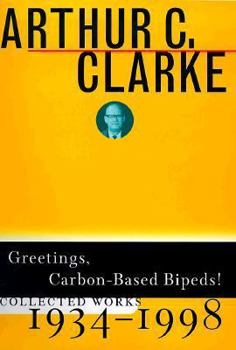
Greetings, Carbon-Based Bipeds!

Select Format
Select Condition 
Book Overview
Arthur C. Clarke is one of this century's most visionary and versatile thinkers. In the crowning achievement of his extraordinary career, Clarke has collected his ground-breaking non-fiction pieces... This description may be from another edition of this product.
Format:Hardcover
Language:English
ISBN:0312198930
ISBN13:9780312198930
Release Date:August 1999
Publisher:St. Martin's Press
Length:558 Pages
Weight:2.15 lbs.
Dimensions:9.8" x 1.8" x 6.5"
Customer Reviews
5 ratings
Essential
Published by Thriftbooks.com User , 24 years ago
Before Carl Sagan (whom, one learns, was himself turned on to science through the words of Sir Arthur), Arthur C. Clarke, in addition to being one of the world's leading and best science fiction writers, was perhaps the most important, and most widely read, science writers of the 20th century. He published several books that are classics in the field of astronomy and physics, such as Interplanetary Flight (the volume that turned on Sagan), The Exploration of Space (the first English language boook to lay out the basic principles, and Clarke's first successful publication), The Promise of Space, Voices From The Sky, Profiles of The Future, and many, many others. Unfortunately, due to the somewhat ephermal nature of these works - as opposed to his science fiction - most of them have been out of print for many years. This is a shame, as Clarke's writing brilliance, smooth of prose, elegant wit, and wry sense of humor come through just as clearly in his non-fiction as in his fiction. He has that great talent of explaining difficult concepts in simple fashion, through analogy, metaphor, and other practible devices, while still remaining informative and literate, and without resorting to condescending. Thankfully, this book has solved much of our problems. Many of Sir Arthur's best and most invigorating essays, covering a nearly 60-year period, are reproduced here, in permanent form - and what a beautiful volume it is, too. A lot of the writing focuses on scientific topics, yes - particularly astronomy and physics - but a good deal of the book deals not with science, but with a variety of other subjects. These include Clarke's numerous postings to the Journal of the British Interplanetary Society, Royal Astronomical Society, and various magazines; personal reminisces (including several documentary-style writings on his scuba diving adventures - unlike many reviewers, who have commented that these essays seemed boring to them, I found them quite a good and fun read, and they led me to decide to go back and read some of Clarke's entire books on this subject, long ignored by me for this same oversight); forwards to books by other people; reviews (it is interesting to see how Clarke views certain classic science fiction movies and books, as well as his fellow science fiction authors and scientific colleagues - many of whom are mentioned, and recounted in loving detail (the book includes tributes to Robert A. Heinlein, Isaac Asimov, Carl Sagan, Stanley Kubrick, Willy Ley, Jack Williamson, Robert Bloch, among others... in addition to many mentions of other such notables as Ray Bradbury, Stephen Hawking, Werner van Braun, and many others) speeches, television appearances, etc. Most all of these are informative, many of them entertaining, and all of them readable. Better selections could perhaps have been made, it is true: I would rather have seen more of his incredible 1960's essays from Voices From The Sky and Profiles of The Future (several of which, for in
Enlightened prediction is the name of the game.
Published by Thriftbooks.com User , 25 years ago
The fiction of Arthur C. Clarke has educated and enlightened multiple generations of readers with works that brought the future to us at an accessible, understandable level. Some of my favorites include Imperial Earth, The Fall of Moondust, and The Fountains of Paradise. And in this year, one must honor the classic "2001: A Space Odyssey."Neil McAleer's biography of Sir Arthur C. Clarke is perhaps one of the best books to give a full understanding of this most versatile and visionary thinker of the twentieth century; but it is only through reading the non-fiction writings that one truly gets to know what a brilliant visionary that Arthur C. Clarke truly is. He has put out numerous papers, articles and books--but they generally have been out of print for many years--which is what makes this collection of essays so wonderful. Here is a logically organized anthology that brings together diverse areas of thought including science, science fiction, politics and more. It does not strive to be a complete collection, but more an essential sampler serving as a tribute to this most knowledgeable and witty intellect.If you have not had the joy of reading Arthur C. Clarke's non-fiction, this is a wonderful place to start. If you have not read any in the last decade, this is a nice rememberance. And if you grew up reading his fiction and non-fiction as I have, it makes for a wonderful tribute to a truly phenomenal man.Perhaps there is hope for the future of mankind?
Esays by a good man and a great intellect
Published by Thriftbooks.com User , 26 years ago
As the last of the original "big three" (Isaac Asimov, Robert Heinlein and Arthur Clarke), the author spans the generation that thought many big ideas and saw some of them happen. It is quite interesting to read the essays where no one thought space travel would happen so quickly. Furthermore, once there were human footprints on the moon, no one thought that at least three decades would pass before new ones would be made. All of which verifies one of the points made in some of the essays. We made the moon a goal for all the wrong reasons of international competition and once those reasons no longer existed the will to continue the search appears to be lacking. There are several themes that recur in these essays. 1) The inexorable movement of evolution and how it will eventually lead to the replacement of the human species with something else, perhaps entities with silicon chips for a brain. 2) The absurdity of believing that God would be so malicious to create an overwhelming body of evidence for a universe billions of years old just to confuse humans. 3) An unwillingness to suffer fools gladly, which sometimes led to strained relationships with friends, in particular a rift with Robert Heinlein over Heinlein's support for the massive and unworkable Strategic Defense Initiative. 4) A tremendous passion for life and all the promises that it has to offer. I found the reading of these essays to be an uplifting experience. Even though his frustration at some of the political and prejudicial stupidities we find ourselves in comes through, it is written in such good humor that you don't mind. Perhaps that is the sign of a great writer. Someone who can take a depressing fact and present it in a way that makes you happy you read it. Although the field of science fiction is more popular now than ever before, it is clear that in some ways things have not changed for the better. Without question, the time when the big three were writing their best work is one that can be described by the biblical phrase, `there were giants in those days.' Many of the footprints are in this book.
Clarke is the greatest among science-fiction writers
Published by Thriftbooks.com User , 26 years ago
In the range of topics and quality of writing, no one surpasses Clarke. What I like about Clarke's writings is that they contain as much science as fiction. As a prophet, he is incomparable. I recommend this book to everyone, especially all Clarke fans and non-fans alike.
good collection of Clarke's essay's
Published by Thriftbooks.com User , 27 years ago
This is a good collection of Arthur C. Clarkes essay's on several subjects from over the course of his career. Anybody who reads a lot of Science writing and/or Science Fiction would like to read this book. Clarke is one of the best writers of Science fact and Science Fiction of the century. Great author. Great book.
Copyright © 2026 Thriftbooks.com
Terms of Use | Privacy Policy | Do Not Sell/Share My Personal Information | Cookie Policy | Cookie Preferences | Accessibility Statement
ThriftBooks ® and the ThriftBooks ® logo are registered trademarks of Thrift Books Global, LLC
ThriftBooks ® and the ThriftBooks ® logo are registered trademarks of Thrift Books Global, LLC
