


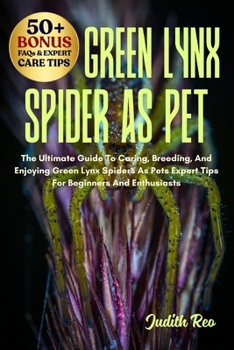
Green Lynx Spider as Pet: The Ultimate Guide To Caring, Breeding, And Enjoying Green Lynx Spiders As Pets Expert Tips For Beginners And Enthusiasts
No Customer Reviews

Introduction to the Green Lynx Spider
The Green Lynx Spider (Peucetia viridans) is a remarkable arachnid that draws attention not just for its striking emerald coloration, but also for its agility, precision hunting skills, and fascinating natural history. This spider is one of the most visually stunning arachnids native to North and Central America, and its name reflects both its distinctive appearance and its predatory prowess-much like the feline lynx, it is a stealthy, patient, and lightning-fast hunter.
1. Scientific Classification and Taxonomy
Before diving into its physical beauty and quirks, it helps to understand where the Green Lynx Spider fits in the animal kingdom:
Kingdom: Animalia
Phylum: Arthropoda
Class: Arachnida
Order: Araneae
Family: Oxyopidae
Genus: Peucetia
Species: Peucetia viridans
The family Oxyopidae-commonly called lynx spiders-contains agile, free-roaming hunters that do not spin webs to catch prey. Instead, they rely on their keen eyesight, speed, and ambush techniques to capture insects. The genus Peucetia is notable for its bright green members, with P. viridans being the most well-known in North America.
2. Geographic Range and Natural Habitat
The Green Lynx Spider is primarily found in:
Southern United States - Particularly in warmer states such as Texas, Florida, Arizona, and California.
Mexico and Central America - Extending through countries such as Guatemala, Honduras, Nicaragua, and Costa Rica.
Parts of the Caribbean - Some populations are known in the Bahamas and other islands.
Their preferred habitat is sunny, open areas with abundant vegetation. They are most commonly seen in:
Gardens and shrubs
Fields and meadows
Agricultural crops (where they often serve as natural pest control)
Flowering plants, where they perch and wait for pollinators
They thrive in environments with moderate to high humidity, good air circulation, and plenty of prey. The ability to blend seamlessly into green foliage makes them superb ambush predators.
3. Physical Appearance and Identification
The Green Lynx Spider's visual appeal is one of the main reasons it captures human interest. They exhibit a brilliant, leaf-like green coloration that is not only beautiful but also highly functional for camouflage.
1 Body Size
Adult females typically measure 12-22 mm in body length.
Males are smaller, usually 12-18 mm.
Leg span can reach up to 4-5 cm, giving them a wide and agile stance.
2 Coloration
Body - Bright green overall, sometimes with a subtle yellowish tint depending on lighting.
Markings - Red spots or lines often run along the dorsal surface of the abdomen, sometimes forming irregular patterns.
Eyes - Arranged in a distinctive hexagonal pattern, providing excellent vision.
Legs - Long, slender, and covered in black spines; semi-transparent green with occasional orange joints.
3 Seasonal Color Changes
A fascinating trait of the Green Lynx Spider is its ability to change shades slightly depending on environmental factors such as background color and seasonal shifts. This allows them to remain concealed against both green leaves in summer and yellowing plants in autumn.
4. Unique Traits and Adaptations
1 Hunting Style
Unlike orb weavers, Green Lynx Spiders do not spin webs to trap prey. They are active hunters, stalking insects and leaping onto them with astonishing speed. Their name "lynx" is inspired by this cat-like hunting method.
2 Excellent Eyesight
The arrangement of their eight eyes gives them nearly 360-degree vision. This acute eyesight is rare among spiders and helps them detect even the slightest movement.
3 Camouflage Ability
Their bright green body blends perfectly with foliage. They often remain motionless for long periods, waiting for prey to approach-an ambush tactic that conserves energy.
The Green Lynx Spider (Peucetia viridans) is a remarkable arachnid that draws attention not just for its striking emerald coloration, but also for its agility, precision hunting skills, and fascinating natural history. This spider is one of the most visually stunning arachnids native to North and Central America, and its name reflects both its distinctive appearance and its predatory prowess-much like the feline lynx, it is a stealthy, patient, and lightning-fast hunter.
1. Scientific Classification and Taxonomy
Before diving into its physical beauty and quirks, it helps to understand where the Green Lynx Spider fits in the animal kingdom:
Kingdom: Animalia
Phylum: Arthropoda
Class: Arachnida
Order: Araneae
Family: Oxyopidae
Genus: Peucetia
Species: Peucetia viridans
The family Oxyopidae-commonly called lynx spiders-contains agile, free-roaming hunters that do not spin webs to catch prey. Instead, they rely on their keen eyesight, speed, and ambush techniques to capture insects. The genus Peucetia is notable for its bright green members, with P. viridans being the most well-known in North America.
2. Geographic Range and Natural Habitat
The Green Lynx Spider is primarily found in:
Southern United States - Particularly in warmer states such as Texas, Florida, Arizona, and California.
Mexico and Central America - Extending through countries such as Guatemala, Honduras, Nicaragua, and Costa Rica.
Parts of the Caribbean - Some populations are known in the Bahamas and other islands.
Their preferred habitat is sunny, open areas with abundant vegetation. They are most commonly seen in:
Gardens and shrubs
Fields and meadows
Agricultural crops (where they often serve as natural pest control)
Flowering plants, where they perch and wait for pollinators
They thrive in environments with moderate to high humidity, good air circulation, and plenty of prey. The ability to blend seamlessly into green foliage makes them superb ambush predators.
3. Physical Appearance and Identification
The Green Lynx Spider's visual appeal is one of the main reasons it captures human interest. They exhibit a brilliant, leaf-like green coloration that is not only beautiful but also highly functional for camouflage.
1 Body Size
Adult females typically measure 12-22 mm in body length.
Males are smaller, usually 12-18 mm.
Leg span can reach up to 4-5 cm, giving them a wide and agile stance.
2 Coloration
Body - Bright green overall, sometimes with a subtle yellowish tint depending on lighting.
Markings - Red spots or lines often run along the dorsal surface of the abdomen, sometimes forming irregular patterns.
Eyes - Arranged in a distinctive hexagonal pattern, providing excellent vision.
Legs - Long, slender, and covered in black spines; semi-transparent green with occasional orange joints.
3 Seasonal Color Changes
A fascinating trait of the Green Lynx Spider is its ability to change shades slightly depending on environmental factors such as background color and seasonal shifts. This allows them to remain concealed against both green leaves in summer and yellowing plants in autumn.
4. Unique Traits and Adaptations
1 Hunting Style
Unlike orb weavers, Green Lynx Spiders do not spin webs to trap prey. They are active hunters, stalking insects and leaping onto them with astonishing speed. Their name "lynx" is inspired by this cat-like hunting method.
2 Excellent Eyesight
The arrangement of their eight eyes gives them nearly 360-degree vision. This acute eyesight is rare among spiders and helps them detect even the slightest movement.
3 Camouflage Ability
Their bright green body blends perfectly with foliage. They often remain motionless for long periods, waiting for prey to approach-an ambush tactic that conserves energy.
Format:Paperback
Language:English
ISBN:B0FPTKLQYN
ISBN13:9798262703692
Release Date:September 2025
Publisher:Independently Published
Length:184 Pages
Weight:0.56 lbs.
Dimensions:0.4" x 6.0" x 9.0"
Customer Reviews
0 rating
Copyright © 2025 Thriftbooks.com
Terms of Use | Privacy Policy | Do Not Sell/Share My Personal Information | Cookie Policy | Cookie Preferences | Accessibility Statement
ThriftBooks ® and the ThriftBooks ® logo are registered trademarks of Thrift Books Global, LLC
ThriftBooks ® and the ThriftBooks ® logo are registered trademarks of Thrift Books Global, LLC
