


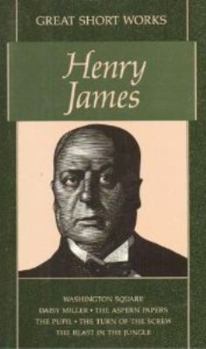
Great Short Works of Henry James


Select Format
Select Condition 
Book Overview
Introduction by Dean Flower. Bibliography & Bibliography Sketch. Volume contains some of James's best short stories: WASHINGTON SQUARE / THE ASPERN PAPERS / THE PUPIL / THE TURN OF THE SCREW / THE... This description may be from another edition of this product.
Format:Hardcover
Language:English
ISBN:0880298162
ISBN13:9780880298162
Release Date:January 1992
Publisher:Dorset House Publishing Co Inc
Weight:1.40 lbs.
Customer Reviews
2 ratings
Great for 2008
Published by Thriftbooks.com User , 18 years ago
I read the Pupil story again this week, and I am surprised how much more I learn from it now than five years ago. I still think it is about what America is trying to offer the rest of the world, but now intellectual activity is so empty, it is easy to see that McFadden is right in his book Discovering the Comic, we apply sitcom expectations to how we few things, and the eleven-to-fifteen-year-old-student in the story is able to offer actual experiences to the young man who spent his life in school. TV laugh tracks help convince us that we are each a small part of a bunch of snickering idiots, and Morgan Moreen would be the best character in a sitcom at the most cultured level. McFadden mentions a shipwreck and a lifeboat in figuring out what the plot of the story turns out to be. Running out of money is funny in a way that makes Henry James a comic writer, according to the conclusions of Discovering the Comic.
A heavy thinker of 100 years ago
Published by Thriftbooks.com User , 23 years ago
The Introduction by Dean Flower to GREAT SHORT WORKS OF HENRY JAMES contains one of the few misprints I found in the book. Instead of `her,' the description of "The Turn of the Screw" which correctly states, "it is her ordeal to be the only one who sees" when the ghosts appear, then has "but here ordeal subtly changes into obsession." (p. ix). In the story, "The Beast in the Jungle," the word `bankrupt' is given an extra r, so the list of things which the main character has not been branded by reads, "It wouldn't have been failure to be brankrupt, dishonoured, pilloried, hanged; it was failure not to be anything." (p. 471).The characters in "The Beast in the Jungle" are man and woman, concerned with an idea which she brings up when they finally meet again, "that again and again has made me think of you since; it was that tremendously hot day when we went to Sorrento, across the bay, for the breeze." (p. 453). Mostly he had tried to remove the element of comedy from their conversation. "What he had asked of her had been simply at first not to laugh at him. She had beautifully not done so for ten years, and she was not doing so now." (p. 455). He had furnished a deep sense of foreboding that he might be overwhelmed by something "possibly annihilating everything, striking at the root of all my world and leaving me to the consequences, however they shape themselves." (p. 456). After ten years of thinking about how it might happen, she was brave enough to ask, "Isn't what you describe perhaps but the expectation--or at any rate the sense of danger, familiar to so many people--of falling in love?" (p. 456). Those who have fallen off the deep end in the other direction might have more ideas for weird movies than this story ends up with.On a more comic note, I think this book illustrates American ideas as being like a little girl who is expecting to be queen of the world, but when she is growing up, she discovers that she is only Daisy Miller. The story, "The Pupil," might be a sign of how readily America could adopt the task of teaching the rest of the world America's democratic values, only to discover that the world doesn't want to be pandered to as much as it would like real support. Short works of Henry James amount to only six stories in 490 pages, ranging from 18,000 to 71,000 words each.I also have a book by Stephen Donadio called NIETZSCHE, HENRY JAMES, AND THE ARTISTIC WILL. Published in 1978, a major part of that book (pages 62-118) started me thinking about the relationship of "American Identity, Universal Culture, and the Unbounded Self." Henry James was born a year before Nietzsche and lived to the middle of World War I, so their lives had some common elements, and Donadio had a lot to say about Ralph Waldo Emerson, who died in 1882, as someone who appeared to be one of the most advanced thinkers of the time to both Nietzsche and Henry James. Donadio's index lists four of the stories in GREAT SHORT WORKS OF HENRY JAMES, a
Copyright © 2026 Thriftbooks.com
Terms of Use | Privacy Policy | Do Not Sell/Share My Personal Information | Cookie Policy | Cookie Preferences | Accessibility Statement
ThriftBooks ® and the ThriftBooks ® logo are registered trademarks of Thrift Books Global, LLC
ThriftBooks ® and the ThriftBooks ® logo are registered trademarks of Thrift Books Global, LLC
