


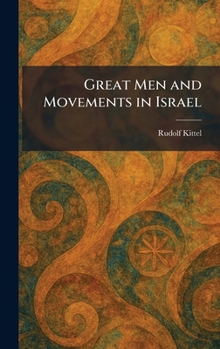
Great Men and Movements in Israel

Select Format
Select Condition 
Book Overview
"Great Men and Movements in Israel" offers a profound exploration of the historical and spiritual forces that shaped the ancient nation of Israel. Written by the renowned scholar Rudolf Kittel, this work provides a comprehensive analysis of the pivotal figures and transformative periods in biblical history. From the foundational leadership of Moses to the rise of the monarchy under David and Solomon, and the moral clarion calls of the great prophets, Kittel examines how individual character and collective religious movements interacted to forge a unique national identity.
The narrative delves into the complexities of Israel's development, situating its leaders within their broader Near Eastern context. Kittel's scholarly approach combines historical rigor with a deep understanding of the theological evolutions that defined the Old Testament era. This book remains an essential resource for students of biblical studies, ancient history, and theology, providing invaluable insights into the enduring legacy of Israel's great leaders and the movements they inspired. It captures the struggle, faith, and political shifts of a people whose influence continues to resonate through modern culture and religion.
This work has been selected by scholars as being culturally important, and is part of the knowledge base of civilization as we know it. This work was reproduced from the original artifact, and remains as true to the original work as possible. Therefore, you may see the original copyright references, library stamps (as most of these works have been housed in our most important libraries around the world), and other notations in the work.
This work is in the public domain in the United States of America, and possibly other nations. Within the United States, you may freely copy and distribute this work, as no entity (individual or corporate) has a copyright on the body of the work.
As a reproduction of a historical artifact, this work may contain missing or blurred pages, poor pictures, errant marks, etc. Scholars believe, and we concur, that this work is important enough to be preserved, reproduced, and made generally available to the public. We appreciate your support of the preservation process, and thank you for being an important part of keeping this knowledge alive and relevant.
Customer Reviews
ThriftBooks® and the ThriftBooks® logo are registered trademarks of Thrift Books Global, LLC
