


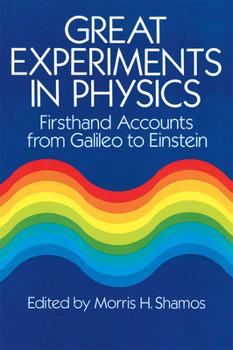
Great Experiments in Physics: Firsthand Accounts from Galileo to Einstein


Select Format
Select Condition 
Book Overview
From Galileo's famous experiments in accelerated motion to Einstein's revolutionary theory of relativity, the experiments recorded here trace the evolution of modern physics from its beginnings to the mid-twentieth century. Brought together for the first time in one volume are important source readings on 25 epochal discoveries that changed man's understanding of the physical world. The accounts, written by the physicists who made them, include: Isaac Newton: The Laws of Motion Henry Cavendish: The Law of Gravitation Augustin Fresnel: The Diffraction of Light Hans Christian Oersted: Elecromagnetism Heinrich Hertz: Electromagnetic James Chadwick: The Neutron Niels Bohr: The Hydrogen Atom, and 17 more. Morris H. Shamos, Professor Emeritus of Physics at New York University, has selected and edited the first published accounts of these important experiments and has also added numerous marginal notes that amplify and clarify the original documents. Moreover, the first 19 experiments can be readily re-created by students in a first-year physics course, making the book ideal for classroom and laboratory work as well as individual reference and study. Finally, Dr. Shamos has provided revealing biographical sketches of the scientists and illuminating references to the political and cultural milieu in which the discoveries are made. The result is a superbly readable presentation -- accessible to lay readers -- of the crucial theoretical and empirical breakthroughs that altered the course of modern science.
Format:Paperback
Language:English
ISBN:0486253465
ISBN13:9780486253466
Release Date:May 1987
Publisher:Dover Publications
Length:384 Pages
Weight:1.19 lbs.
Dimensions:0.7" x 6.5" x 9.2"
Customer Reviews
3 ratings
Ok sourcebook
Published by Thriftbooks.com User , 18 years ago
This is a haphazard sourcebook with mediocre, short introductions to each paper that are almost entirely biographical. Some of the selections are not really experiments at all, e.g. the usual excerpts from Galileo and Newton on mechanics and most of the 80-page appendices (Maxwell, Einstein, Bohr, etc.). Others are more measurements than "great experiments", e.g. Boyle, Coulomb, Cavendish. Isolated but interesting selections are Young and Fresnel on light (no Newton here), Röntgen on x-rays, Becquerel on radioactivity. The only reasonably coherent thread that one can follow through the book is electromagnetism. I shall summarise the main points briefly. Coulomb (1785) discovered his "fundamental law by which electrified bodies repel each other", namely that the repulsive force is inversely proportional to the square of the distance, as is the attractive force between opposite charges. But this is the same law as for magnets. Thus "The magnetic fluid seems to have, if not by its nature, at least by its properties an analogy with the electric fluid. Based on this analogy it can be assumed that the two fluid obey the same laws. In all other phenomena of attractions or repulsion that nature presents to us, for instance elasticity and chemical affinity, the forces seem to be exerted only at very small distances, and it seems, therefore, that they are nothing but the same laws of electricity and magnetism." The link between electricity and magnetism was further strengthened when Oersted (1820) discovered that a current can influence a magnetic needle. Apparently the current generates some sort of "electric conflict" which "is not enclosed in the conductor, but ... is at the same time dispersed in the surrounding space, and that somewhat widely". "All nonmagnetic bodies seem seem to be penetrable through electric conflict; but magnetic bodies, or rather their magnetic particles, seem to resist the passage of this conflict, whence it is that they can be moved by the impulse of contending forces." Faraday (1832) discovered further that currents can induce currents (albeit weak ones: "I could obtain no evidence by the tongue") and that magnets can induce currents. As for the nature of this electromagnetic business, Faraday (1834) made some discoveries on electrolysis. Water can be decomposed into hydrogen and oxygen by sticking two metal plates in it and connecting them with a current, and Faraday discovered that "when subjected to the influence of the electric current, a quantity of it is decomposed exactly proportionate to the quantity of electricity which has passed" and thus "it seems probable, and almost a natural consequence, that the quantity which passes is the equivalent of, and therefore equal to, that of the particles separated; i.e., that if the electrical power which ... makes a grain of oxygen and hydrogen in the right proportions unite into water ... could be thrown into the condition of a current, it would exactly equal the current requ
Excellent starter volume
Published by Thriftbooks.com User , 19 years ago
Ok, so, this is a good book. If you are interested in the history of science or just physics, and you want to break into primary sources but feel a little overwhelmed, then I recommend going ahead and buying this book, because it's cheap, and flipping to the first chapter that catches your eye. You will probably like what you see: English translation of texts by Galileo, Boyle, Cavendish, etc., which are short excerpts of the "good part". In the margins, there are commentaries to help you out with archaic language and "weirder" aspects. Now you're cooking! You can go on to other reading if you want.
Essential !!!
Published by Thriftbooks.com User , 26 years ago
I strongly recommend this book for everyone interested in physics. Professor Shamos did a fantastic job in collecting in one single book the experiments and original works of the main geniuses of the history of physics. It's so much more interesting and easy to understand the principles when you visualize the context in which they were developed. Such literature must be obrigatory for every student of physics !!
Copyright © 2026 Thriftbooks.com Terms of Use
| Privacy Policy | Do Not
Sell/Share My Personal Information | Cookie Policy | Cookie Preferences | Accessibility Statement
ThriftBooks® and the ThriftBooks® logo are registered trademarks of Thrift Books Global, LLC
ThriftBooks® and the ThriftBooks® logo are registered trademarks of Thrift Books Global, LLC
