


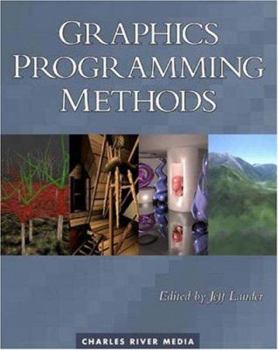
Graphics Programming Methods (Graphics Series)


The articles in this text provide specific techniques for well-defined problems facing graphics programmers in the production of a variety of projects, including visual effects, real-time graphics and... This description may be from another edition of this product.
Format:Hardcover
Language:English
ISBN:1584502991
ISBN13:9781584502999
Release Date:July 2003
Publisher:Charles River Media
Length:432 Pages
Weight:2.10 lbs.
Dimensions:9.8" x 1.5" x 7.8"
Customer Reviews
1 rating
Look at the Facial Methods
Published by Thriftbooks.com User , 22 years ago
Graphics programming has been amazingly successful in the last twenty years, driven by Moore's Law and a lot of smart researchers, like those who contributed to this book.The attraction here is that you can see what are the major current problems in graphics. Whereas 15 years ago, say, texture maps and NURBS would have been cutting edge, now those have been incorporated into most software packages and even hardware.There is still more to be done with fractals, as the book reveals. Better, more lifelike landscapes, for example.But perhaps the hardest, and least developed aspect treated in the book is that of modelling human faces, and the inverse problem of recognising faces from actual photographs. This is not meant as a criticism of those authors discussing it. Rather it is because of evolution. How does an animal recognise another of its own species? Ever since sight evolved, this is a fundamental issue that is crucial to species propagation. Hence, when you recognise a familiar face, you are invoking old and opaque algorithms buried deep in our brain. As a result, when you look at a computer generated human face, you are far more likely to find something "off" about it than you are with an image of a tree.The book's facial methods are an excellent start to this problem. But much remains to be done.
Copyright © 2026 Thriftbooks.com Terms of Use
| Privacy Policy | Do Not
Sell/Share My Personal Information | Cookie Policy | Cookie Preferences | Accessibility Statement
ThriftBooks® and the ThriftBooks® logo are registered trademarks of Thrift Books Global, LLC
ThriftBooks® and the ThriftBooks® logo are registered trademarks of Thrift Books Global, LLC
