


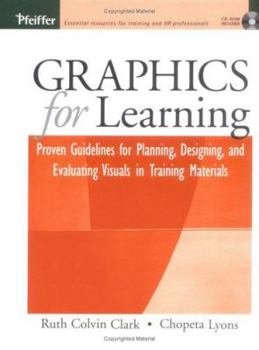
Graphics for Learning: Proven Guidelines for Planning, Designing, and Evaluating Visuals in Training Materials


Select Format
Select Condition 
Book Overview
Graphics for Learning teaches you how to design effective graphics for print or online and computer-generated materials--multimedia, texts, working aids, and slides--that will maximize learning, understanding, and reasoning. Based on solid research on how people learn, this crucial resource contains best practices and shows you how to go beyond the visible features of graphics to plan visuals that are based on their communication and psychological functions. Written by instructional design experts Ruth Colvin Clark and Chopeta Lyons, Graphics for Learning includes a graphic design model that guides you through the visual planning process--from needs assessment through production. No matter how much or little expertise you have working with graphics, this book will help you boost your return on investment by giving you the information you need to design and implement the most effective visuals. Graphics for Learning shows how to: Select the graphics that can impr ove learning and workplace performance. Plan the most appropriate visual for computer or paper instructional materials. Design the best graphics for instructional content. Tailor visuals for individual learners. Avoid using the wrong visuals for motivational purposes. Understand the characteristics of graphics that support (or disrupt) learning. Follow a systematic graphic design model that helps you plan graphics that match your instructional context.
Format:Hardcover
Language:English
ISBN:078796994X
ISBN13:9780787969943
Release Date:May 2004
Publisher:Pfeiffer
Length:544 Pages
Weight:2.70 lbs.
Dimensions:9.4" x 1.7" x 7.3"
Customer Reviews
4 ratings
Outstanding Resource for Instructional Designers!
Published by Thriftbooks.com User , 18 years ago
Ruth Clark is one of the most practical theorists working in the Instructional Design field today. Her work is backed by sound research, is always clear & well organized, and (most importantly) can be directly applied in the design and development of engaging learning products. Her partnership with Chopeta Lyons on this book paid off wonderfully. Together, they've created a wonderful resource to anyone creating visuals to support learning products. As always with Clark, the research is complete and well presented to support her ideas and guidelines; the examples accompanying the guidelines are plentiful and are also available on a CD-ROM included with the book. Key topics in the book include the functions of graphics in learning products, a systematic visual design process to use when planning your instructional graphics, using graphics to activate learning, and using appropriate graphic strategies to support specific information types. Each section contains practical guidelines, which are clearly explained and supported by research -- here is just a small sample of the guidelines taken from various chapters of the book (minus their explanations & examples): "Use Signals and Cues to draw attention to important content." (Attention) "Use graphics in place of text when the content can be communicated more efficiently visually." (Memory Load) "Plan graphics that are consistent in style and low in complexity." (Memory Load) "Use organizational visuals such as graphic organizers to show qualitative relationships among lesson content." (Building Mental Models) "For online practice of computer procedures, support transformational visuals with on-screen contiguous text to provide directions, feedback, and memory support." (Procedures) "Use interpretive visuals such as schematics and visual analogies to represent abstract processes such as how computer program code works." (Processes) "Create project specific standards and guidelines through samples, prototypes, templates, and appropriate documentation." (Communicate Your Graphic Plans) Unexpected extras? Two case studies and a really cool glossary of terms for Instructional Design Geeks!!
For Instructional Designers In Any Visual Medium
Published by Thriftbooks.com User , 20 years ago
This is a natural follow-up to Ms. Clark's "e-Learning and the Science of Instruction." For me, no other author has written about e-Learning visual and textual design and content, with the authority, clearity, and explicitness as Ms. Clark. "Graphics for Learning," clearing links design concepts to supporting reseach in a manner not often found in instructional and graphic design books. I appreciate reading facts and not someone's opinion about why one should do one thing or the other. Especially for those designing e-Learning or distance learning this is a must have book.
The Best of Both Worlds
Published by Thriftbooks.com User , 21 years ago
"Graphics for Learning" takes on the challenging task of bridging two ways of looking at instructional graphics: the academic research that deals with how people learn from graphics and the practical application of that research. You don't need a Phd to read and understand the research findings, as Clark and Lyons summarize and explain them well, with ample use of helpful graphics. The books flows easily from the foundation of research into the practical planning of graphics for instruction. The emphasis is always on the crucial process of planning and thinking about graphics that support learning goals and fit the situation. The authors do a good job of integrating case studies and examples to make their points clear. One thing I especially appreciate is that Clark and Lyons recognize the realities of time and budget constraints and offer advice and examples that work whether the budget is large or small. This book is an excellent resource for instructional designers and others who are serious about taking their communications to a higher level of effectiveness.
Very Useful Reference
Published by Thriftbooks.com User , 21 years ago
It is usually quite difficult to find a good How-To book in the Infographics/Instructional Design arena. So, I was quite delighted to discover this book by Dr Ruth Clark and another book (Creating Graphics for Learning and Performance : Lessons in Visual Literacy) by Dr Linda Lohr. I have found these information very useful: - 7 communication functions of graphics (decorative, representational, mnemonic, organizational, relational, transformational, interpretive) - mapping of appropriate graphical functions (or types) to different content types (facts, concepts, processes, procedures, principles) - numerous graphical examples for different content types - numerous instructional design tips, e.g., chunking and sequencing to minimizing memory load, use of visual cues to direct attention, use of certain graphic types to build mental models (e.g., cause and effect) What would have been even more useful could be the setup of an online Infographic Design resource where members of the public can collaboratively view, discuss and refine the guidelines, use and contribute more examples (especially), etc. Would certainly look forward to be involved in such an endeavor.
Copyright © 2026 Thriftbooks.com Terms of Use
| Privacy Policy | Do Not
Sell/Share My Personal Information | Cookie Policy | Cookie Preferences | Accessibility Statement
ThriftBooks® and the ThriftBooks® logo are registered trademarks of Thrift Books Global, LLC
ThriftBooks® and the ThriftBooks® logo are registered trademarks of Thrift Books Global, LLC
