


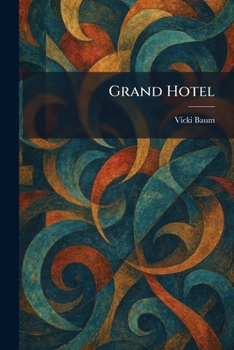
Grand Hotel

"Grand Hotel" is a landmark of early 20th-century literature that presents a vivid, panoramic view of life within the walls of a bustling Berlin luxury establishment. Through a series of interlocking narratives, Vicki Baum captures the essence of the Weimar Republic era, weaving together the destinies of diverse guests whose paths cross in the hotel's opulent lobby and quiet corridors.
The story follows a cast of unforgettable characters: a fading Russian ballerina seeking a final spark of fame, a terminally ill bookkeeper determined to live his last days in splendor, a charming but desperate thief, and a cynical doctor who observes the transient nature of human existence. As their lives collide over the course of a few days, the work explores profound themes of loneliness, chance, and the search for connection in an increasingly impersonal world.
Written with cinematic flair and sharp social observation, "Grand Hotel" remains a powerful exploration of the human condition and the social dynamics of post-war Europe. Its masterful use of the 'multi-protagonist' structure has influenced countless works of fiction and film, making it a timeless classic of modern storytelling.
This work has been selected by scholars as being culturally important, and is part of the knowledge base of civilization as we know it. This work was reproduced from the original artifact, and remains as true to the original work as possible. Therefore, you may see the original copyright references, library stamps (as most of these works have been housed in our most important libraries around the world), and other notations in the work.
This work is in the public domain in the United States of America, and possibly other nations. Within the United States, you may freely copy and distribute this work, as no entity (individual or corporate) has a copyright on the body of the work.
As a reproduction of a historical artifact, this work may contain missing or blurred pages, poor pictures, errant marks, etc. Scholars believe, and we concur, that this work is important enough to be preserved, reproduced, and made generally available to the public. We appreciate your support of the preservation process, and thank you for being an important part of keeping this knowledge alive and relevant.
Customer Reviews
ThriftBooks ® and the ThriftBooks ® logo are registered trademarks of Thrift Books Global, LLC
