


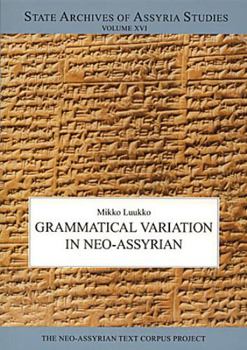
Grammatical Variation in Neo-Assyrian
No Customer Reviews

Variation is a prerequisite of change ...without synchronic variation, change would not have a launching pad." Thus says Raimo Anttila in his Historical and Comparative Linguistics . The problem with ancient languages is that it is difficult to get enough texts to be able to document variation. In this respect, the Neo-Assyrian period stands apart from most of the other eras of the Ancient Near East. The century after the coming to power of the Sargonid kings in 722 BCE is documented by thousands of preserved letters between bureaucrats of the royal administration written in the Neo-Assyrian dialect/language. The value of this letter corpus for being able to document synchronic variation in Neo-Assyrian is difficult to overstate. And this is in addition to the wide range of other types of texts available from this period. On the basis of this extensive corpus, it is possible to define variation in great detail across the grammatical spectrum: in graphotactics, in phonology, in morphology, in syntax, and in semantics. Thousands of detailed examples make the extent of synchronic variation in Neo-Assyrian explicit in a way that would not be possible without such wide-ranging documentation. Two detailed appendices on the letter corpus itself and on the senders of the letters would make useful handbooks on their own. And the discussed terms and the cited passages are fully indexed.
Format:Paperback
Language:English
ISBN:9514590597
ISBN13:9789514590597
Release Date:June 2004
Publisher:Neo-Assyrian Text Corpus Project
Length:296 Pages
Weight:1.36 lbs.
Dimensions:0.6" x 6.8" x 9.8"
Customer Reviews
0 rating
Copyright © 2026 Thriftbooks.com
Terms of Use | Privacy Policy | Do Not Sell/Share My Personal Information | Cookie Policy | Cookie Preferences | Accessibility Statement
ThriftBooks ® and the ThriftBooks ® logo are registered trademarks of Thrift Books Global, LLC
ThriftBooks ® and the ThriftBooks ® logo are registered trademarks of Thrift Books Global, LLC
