


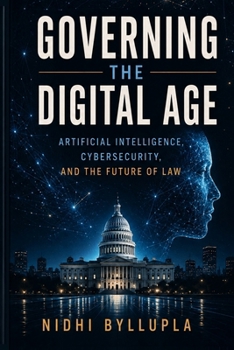
Governing the Digital Age: Artificial Intelligence, Cybersecurity, and the Future of Law

Technology now shapes nearly every part of modern life: but the systems governing it are struggling to keep up.
A ransomware attack can disrupt critical infrastructure. A convincing deepfake can blur the line between truth and fabrication. An algorithm can influence who gets hired, what information people see, and how decisions are made about them. Behind each of these challenges lies a larger question: What happens when technology advances faster than the rules designed to govern it?
Governing the Digital Age explores the growing intersection of artificial intelligence, cybersecurity, law, and public policy. Through real-world cases involving the Colonial Pipeline ransomware attack, the CrowdStrike outage, Cambridge Analytica, AI-generated misinformation, algorithmic bias, software supply-chain vulnerabilities, and emerging AI regulation, the book examines how digital systems are reshaping security, privacy, accountability, and trust.
Rather than treating cybersecurity, artificial intelligence, and technology policy as separate issues, Governing the Digital Age considers how they increasingly collide, and why technical solutions alone are not enough.
As governments, companies, and individuals become more dependent on systems they cannot always see or fully understand, the challenge is no longer simply how to build more powerful technology. It is how to decide what that technology should be allowed to do, who should be responsible when it fails, and how innovation can continue without sacrificing the people expected to trust it.
Accessible to readers interested in technology, cybersecurity, AI, law, and the future of digital governance, Governing the Digital Age examines one of the defining challenges of our time: how to preserve trust in a world increasingly shaped by technology.
Customer Reviews
ThriftBooks ® and the ThriftBooks ® logo are registered trademarks of Thrift Books Global, LLC
