


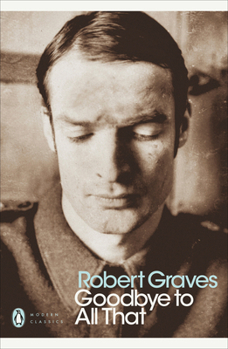
Modern Classics Goodbye To All That (Penguin Modern Classics)


Select Format
Select Condition 
Book Overview
An autobiographical work that describes firsthand the great tectonic shifts in English society following the First World War, Robert Graves's Goodbye to All That is a matchless evocation of the Great War's haunting legacy, published in Penguin Modern Classics. In 1929 Robert Graves went to live abroad permanently, vowing 'never to make England my home again'. This is his superb account of his life up until that 'bitter leave-taking': from his childhood and desperately unhappy school days at Charterhouse, to his time serving as a young officer in the First World War that was to haunt him throughout his life. It also contains memorable encounters with fellow writers and poets, including Siegfried Sassoon and Thomas Hardy, and covers his increasingly unhappy marriage to Nancy Nicholson. Goodbye to All That, with its vivid, harrowing descriptions of the Western Front, is a classic war document, and also has immense value as one of the most candid self-portraits of an artist ever written. Robert Ranke Graves (1895-1985) was a British poet, novelist, and critic. He is best known for the historical novel I, Claudius and the critical study of myth and poetry The White Goddess. His autobiography, Goodbye to All That, was published in 1929, quickly establishing itself as a modern classic. Graves also translated Apuleius, Lucan and Suetonius for the Penguin Classics, and compiled the first modern dictionary of Greek Mythology, The Greek Myths. His translation of The Rub iy t of Omar Khayy m (with Omar Ali-Shah) is also published in Penguin Classics. If you enjoyed Goodbye to All That, you might like Ford Madox Ford's Parade's End, also available in Penguin Modern Classics. 'His wonderful autobiography'
Jeremy Paxman, Daily Mail
Jeremy Paxman, Daily Mail
Format:Paperback
Language:English
ISBN:0141184590
ISBN13:9780141184593
Release Date:October 2000
Publisher:Penguin Classic
Length:288 Pages
Weight:0.65 lbs.
Dimensions:7.8" x 0.7" x 5.1"
Related Subjects
Arts & Literature Authors Biographical Biographies Biographies & History Biography & History Criticism & Theory European Historical History History & Criticism Humanities Literary Criticism Literary Criticism & Collections Literature Movements & Periods Poetry Single Authors World LiteratureCustomer Reviews
3 ratings
Masterful and Ironic Caricatures of Human Folly
Published by Thriftbooks.com User , 22 years ago
"Good-Bye to All That" is one of the most imminently readable autobiographies I have yet come across. Generally, I do not particularly care for the autobiographical genre of writing, nor, based on my public school and university history textbooks, would I have professed much interest in history. Graves' book, however, changes "all that." Two aspects of the book have endeared it to me:First, Graves' writing style is replete with droll, dry wit. His use of irony to paint word pictures in his readers' minds is masterful. His use of language is inspiring to every occasional writer who longs for such skill. His ability to see through the façades of academic reputation in both public school and university, of nationalistic patriotism, of formally organized religion, and of military tradition overcomes popular perception to show the ignorant, delusional, self-serving nature of such things. Never are his unveilings heavy-handed, though. On the contrary, Graves depicts events and presents examples in descriptions that he refers to as "caricatures," but it would be a dull reader indeed who fails to perceive the ironies implicit in these entertaining recitations.Second, Graves' autobiography is revealing of many historical topics that escape adequate coverage in most textbooks. The reader comes away with a much improved understanding of early 20th century British society, education, and culture. Because most of the book deals with Graves' experiences in the trench warfare of World War I, the reader comes to visualize the barbarity and insanity of war more acutely than he may have hitherto done. Then there are tidbits that generally escape the formal history textbooks altogether-the antipathy between British troops and French citizenry that led some Britons to the conclusion that their country had aligned itself with the wrong side in the war; the imprisonment of British residents of German ancestry resulting from war paranoia (foreshadowing America's treatment of its citizens of Japanese ancestry during the next world war); British soldiers' opinion of American "support" as American artillery shells showed themselves frequently to be duds or, worse, to fall short and explode in the British trenches rather than the German. Graves presents us history as he saw it first hand, and we are spell bound by his power as a storyteller.The book also has, from my perspective, two significant weaknesses. First, my command of American English did not always stand me in good stead when confronted by some words and phrases of peculiarly colloquial British usage. This edition of the book does include a short "Glossary for non-British readers," but it needs to be about twice as long for some of us. The second weakness, more of a disappointment, really, is that the narrative stops when Graves is only thirty-three. Even though Graves later appended a brief epilogue, the reader wishes that he had continued his story for many more years, for we come to feel a friendsh
Moving report on the end of an era
Published by Thriftbooks.com User , 23 years ago
I spotted this remarkable book on ... Top 100 Non-Fiction Books of the Century list. In "Good-bye to All That, " the British poet Robert Graves (1895-1985), best known to American readers as the author of the novel of ancient Rome, "I Claudius," writes the autobiography of his youth, justifiably famous for its eloquent but straight-forward depiction of the horrors of WWI, during which Graves spent years in the trenches of France as an army captain.More than the war, however, Graves' topic is the passing of an era: the class-ridden and naïve culture of the Edwardian upper classes, a culture did not survive the war. Graves came from a landed family and received a classic boarding-school education. Even in the trenches officers like Graves had personal servants and took offense when they had to dine with officers of `the wrong sort' (promoted from the lower classes). Graves' narrative itself barely survives the end of the war; the post-war chapters seem listless and shell-shocked, emotionally detached. The battles he survived are written about with precision, gravity, and emotional impact; but Graves' marriage and the birth of his children seem like newspaper reports. Surprisingly, he doesn't even talk of his poetry much. This, surely, is not a defect of the book but a genuine reflection of his feelings at the time: After the War, nothing meant much to him.Graves' literary style is very matter-of-fact--the opposite of the imagistic, adjective-driven language one might expect of a poet. Instead, he had a gift for the right details: in only a sentence or two, by careful description, he can perfectly describe a fellow-soldier or give the exact sense of `being there' in battle. The book is a remarkable achievement worth reading even for those who may be glad the old days were left behind.
Perhaps still the premiere war memoir in English
Published by Thriftbooks.com User , 23 years ago
GOOD-BYE TO ALL THAT is about considerably more than just Graves's experiences in the trenches in WW I, but it is that section of the book that makes this memoir stand apart from most others. That, and the exceptional honesty of the book, which manages to be tell-all without being gossipy. There is also a sense of renunciation; instead of nostalgic longing to recover the past as one find in other memoirs, Graves is anxious to put the past aside for good, to have done with it entirely.The best parts of the book are those dealing with his dreadful time in school, he time serving in the war, and his various friendships. Some of those friendships sneak up on you. He writes at length of a literature professor at school named George Mallory who profoundly molded his reading and literary sensibilities. He writes for page after page about "George," but it isn't until he begin a chapter with the words, "George Mallory did something better than lend me books: he too me climbing on Snowdon in the school vacation." It wasn't until that moment that I realized that George Mallory the literature instructor was THAT George Mallory, the famous mountain climber who attempted Everest (and perhaps conquered it) "because it is there." George becomes one of Graves's greatest friends, and even serves as best man in his wedding. The other friendship I found fascinating, perhaps because the man himself remains one of the most mystifying characters of the 20th century, was T. E. Lawrence. As Lawrence removed himself from the public eye more and more in the 1920s and 1930s, being in 1920 perhaps one of the most famous individuals in the British Empire, he changed personas from Lawrence of Arabia to Private Shaw, reenlisting in the Army as an auto mechanic. Graves remained a good friend of his throughout the entire period, and wrote one of the first serious biographies of Lawrence. I enjoyed one passage where he is in Lawrence's quarters at (I think) Cambridge, eyeing the manuscript of Lawrence's own war memoirs, what would eventually become THE SEVEN PILLARS OF WISDOM (Graves would be one of a select few to receive a copy of the first privately printed edition, which remains one of the great published books of the 20th century, with expensively reproduced drawings and illustrations--subsequent editions remove most of the illustrations).But the heart of the book is the account of his experiences at the front. Although this war produced a disproportionate amount of great literature, I personally believe that the two greatest literary monuments to the Great War (unless one also includes Lawrence's THE SEVEN PILLARS OF WISDOM) are Graves's memoir and the poetry of Wilfrid Owen. The sections of the book dealing with the war seem to alternate between the startling everyday to the nightmarish. In many sections the mood seems to be straight out of Dante's PURGATORIO, at the worst his INFERNO. But throughout, the story is carried forward by Graves's relentlessly honest pen. Althoug
Copyright © 2026 Thriftbooks.com
Terms of Use | Privacy Policy | Do Not Sell/Share My Personal Information | Cookie Policy | Cookie Preferences | Accessibility Statement
ThriftBooks ® and the ThriftBooks ® logo are registered trademarks of Thrift Books Global, LLC
ThriftBooks ® and the ThriftBooks ® logo are registered trademarks of Thrift Books Global, LLC
