


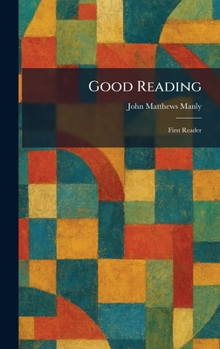
Good Reading: First Reader

"Good Reading. First Reader" is a foundational educational text designed to introduce young learners to the joys of literacy. Developed by John Matthews Manly, a distinguished scholar and educator, this primer serves as an essential stepping stone in the development of early reading skills. Through a carefully curated selection of stories, poems, and exercises, the work guides children from simple phonetic recognition to the comprehension of more complex narrative structures.
The collection emphasizes the relationship between language and imagination, offering a variety of engaging themes that resonate with the experiences and curiosities of early childhood. As a work of pedagogical significance, "Good Reading. First Reader" reflects the instructional methods favored in the early 20th century, focusing on oral reading, repetition, and the cultivation of a rich vocabulary. The book aims to build confidence in emerging readers while fostering an appreciation for classic storytelling.
Ideal for historians of education, collectors of vintage textbooks, or those interested in traditional literacy programs, this volume remains a testament to the enduring methods used to teach the English language. It provides a window into a bygone era of classroom instruction, where the marriage of simple prose and moral instruction helped shape the minds of a generation.
This work has been selected by scholars as being culturally important, and is part of the knowledge base of civilization as we know it. This work was reproduced from the original artifact, and remains as true to the original work as possible. Therefore, you may see the original copyright references, library stamps (as most of these works have been housed in our most important libraries around the world), and other notations in the work.
This work is in the public domain in the United States of America, and possibly other nations. Within the United States, you may freely copy and distribute this work, as no entity (individual or corporate) has a copyright on the body of the work.
As a reproduction of a historical artifact, this work may contain missing or blurred pages, poor pictures, errant marks, etc. Scholars believe, and we concur, that this work is important enough to be preserved, reproduced, and made generally available to the public. We appreciate your support of the preservation process, and thank you for being an important part of keeping this knowledge alive and relevant.
Customer Reviews
ThriftBooks® and the ThriftBooks® logo are registered trademarks of Thrift Books Global, LLC
