


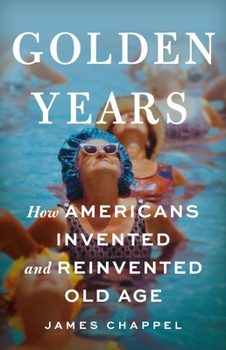
Golden Years: How Americans Invented and Reinvented Old Age


Select Format
Select Condition 
Book Overview
An "essential" (The New Republic) account of the history of old age in modern America, showing how we created unprecedented security for some and painful uncertainty for others On farms and in factories, Americans once had little choice but to work until death. As the nation prospered, a new idea was born: the right to a dignified and secure old age. That project has benefited millions, but it remains incomplete--and today it's under siege. In Golden Years, historian James Chappel shows how old age first emerged as a distinct stage of life and how it evolved over the last century, shaped by politicians' choices, activists' demands, medical advancements, and cultural models from utopian novels to The Golden Girls. Only after World War II did government subsidies and employer pensions allow people to retire en masse. Just one generation later, this model crumbled. Older people streamed back into the workforce, and free-market policymakers pushed the burdens of aging back onto older Americans and their families. We now confront an old age mired in contradictions: ever longer lifespans and spiraling health-care costs, 401(k)s and economic precarity, unprecedented opportunity and often disastrous instability. As the population of older Americans grows, Golden Years urges us to look to the past to better understand old age today--and how it could be better tomorrow.
Format:Hardcover
Language:English
ISBN:1541619528
ISBN13:9781541619524
Release Date:November 2024
Publisher:Basic Books
Length:368 Pages
Weight:1.15 lbs.
Dimensions:1.3" x 6.1" x 9.3"
Customer Reviews
1 rating
Aging, Retirement and Our Moral Reckoning
Published by Randy Ehrler , 3 months ago
I picked up Golden Years hoping for a passionate polemic: a clear-eyed argument for revolutionary change in how we think about aging, retirement, and our shared responsibilities in a longer life.
What James Chappel offers instead is a careful, well-researched history of how America has treated its aging population over the last century. For readers new to this conversation, it’s a valuable foundation. He traces a time before Social Security and Medicare when growing old or losing the ability to work meant real precarity. Unless you had wealth or family to fall back on, you were largely on your own. After World War II, during a brief window of shared prosperity, we decided that this was unacceptable, that people who had contributed over a lifetime deserved dignity, financial security, and medical care. That promise, of course, was never evenly kept, particularly for women and people of color, and Chappel is clear about those failures.
One of the book’s more revealing insights is that retirement itself was not originally desired. Work provided meaning, structure, and community. Retirement had to be invented, and sold. Now, just as it has become the organizing principle of modern adulthood, its foundations are quietly eroding, leaving many exposed and uncertain once again.
Where the book ultimately disappointed me is in what it refuses to do. Chappel lays out the facts but stops short of offering a moral position or a vision for what must come next. And that feels like a missed opportunity. We urgently need to rethink aging and retirement from the ground up, bringing them back to the middle. Today, a small minority enjoys luxury cruises, multiple homes, and endless leisure, while millions of older adults live on the edge of precarity; isolated, under-resourced, and physically broken. That widening gap is not just an economic failure; it is a moral one.
We need a more honest and demanding framework, one that lowers unrealistic expectations of endless leisure, calls us to greater personal responsibility for health and vitality, and fiercely protects the systems that provide a humane floor for all: income above poverty, access to medical care, and basic security in the face of inevitable vulnerability. A winner-takes-all model of aging will not produce a good life, not for those struggling to survive, and not, ultimately, for those insulated by excess.
We are all aging. This is a global and unavoidable shift, and the systems we rely on will not hold as they are. Golden Years helps explain how we arrived here. What it leaves unanswered, and what this moment demands, is a deeper reckoning with who we want to be as a society. This is worth reflecting on.
Copyright © 2026 Thriftbooks.com Terms of Use
| Privacy Policy | Do Not
Sell/Share My Personal Information | Cookie Policy | Cookie Preferences | Accessibility Statement
ThriftBooks® and the ThriftBooks® logo are registered trademarks of Thrift Books Global, LLC
ThriftBooks® and the ThriftBooks® logo are registered trademarks of Thrift Books Global, LLC
