


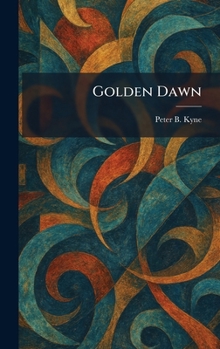
Golden Dawn

"Golden Dawn" is a gripping psychological drama and mystery set against the vibrant backdrop of early 20th-century San Francisco. Written by the prolific storyteller Peter B. Kyne, this novel explores the complex layers of human identity through the life of its protagonist, Penelope Cassell. Known to some as a refined young woman and to others as a denizen of the city's darker underbelly, Penelope suffers from a profound dual personality that leaves her unaware of her own conflicting lives.
The narrative follows the efforts of Dr. Stephen Burt, a dedicated psychiatrist who becomes fascinated by Penelope's condition. As he delves deeper into the mysteries of her subconscious, the story weaves a tale of suspense, romance, and the search for redemption. Kyne masterfully balances the tension of a detective thriller with a poignant look at mental health and the societal pressures of the era.
Rich in atmospheric detail and emotional depth, "Golden Dawn" remains a compelling example of early psychological fiction. Readers will be drawn into a world where the line between innocence and guilt is blurred, and where the dawn of a new life requires confronting the shadows of the past. It is a timeless exploration of the mysteries of the mind and the enduring power of the human spirit.
This work has been selected by scholars as being culturally important, and is part of the knowledge base of civilization as we know it. This work was reproduced from the original artifact, and remains as true to the original work as possible. Therefore, you may see the original copyright references, library stamps (as most of these works have been housed in our most important libraries around the world), and other notations in the work.
This work is in the public domain in the United States of America, and possibly other nations. Within the United States, you may freely copy and distribute this work, as no entity (individual or corporate) has a copyright on the body of the work.
As a reproduction of a historical artifact, this work may contain missing or blurred pages, poor pictures, errant marks, etc. Scholars believe, and we concur, that this work is important enough to be preserved, reproduced, and made generally available to the public. We appreciate your support of the preservation process, and thank you for being an important part of keeping this knowledge alive and relevant.
Customer Reviews
ThriftBooks ® and the ThriftBooks ® logo are registered trademarks of Thrift Books Global, LLC
