


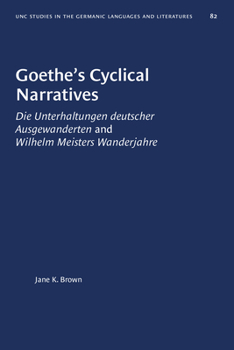
Goethe's Cyclical Narratives: Die Unterhaltungen Deutscher Ausgewanderten and Wilhelm Meisters Wanderjahre
No Customer Reviews

Select Format
Select Condition 
Book Overview
The novelty of this study lies in its techniques for understanding the deliberate narrative contradictions and elusive parody in Goethe's work. Interpretation of the entire Unterhaltungen, including the M rchen, establishes Goethe's principles of cyclical composition. By pursuing the elaboration of these principles in the Wanderjahre -- the undependable narrator, multiple perspectives, and parody of popular eighteenth-century figures -- the author interprets the cultural and social significance of Goethe's most sophisticated novel.
Format:Paperback
Language:English
ISBN:1469657171
ISBN13:9781469657172
Release Date:January 1975
Publisher:University of North Carolina Press
Length:160 Pages
Weight:0.52 lbs.
Dimensions:0.4" x 6.0" x 9.0"
Customer Reviews
0 rating
Copyright © 2025 Thriftbooks.com
Terms of Use | Privacy Policy | Do Not Sell/Share My Personal Information | Cookie Policy | Cookie Preferences | Accessibility Statement
ThriftBooks ® and the ThriftBooks ® logo are registered trademarks of Thrift Books Global, LLC
ThriftBooks ® and the ThriftBooks ® logo are registered trademarks of Thrift Books Global, LLC
