


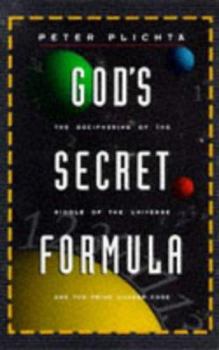
God's Secret Formula: Deciphering the Riddle of the Universe and the Prime Number Code

Select Format
Select Condition 
Book Overview
Holding doctorates in chemistry, physics and biology, Peter Plichta applies his multifaceted scientific knowledge to the search for a universal building plan and makes a profound discovery. Plichta... This description may be from another edition of this product.
Format:Hardcover
Language:English
ISBN:1862040141
ISBN13:9781862040144
Release Date:January 1997
Publisher:Element Books Ltd
Length:218 Pages
Weight:1.34 lbs.
Dimensions:9.8" x 0.8" x 6.5"
Customer Reviews
4 ratings
Comment
Published by Thriftbooks.com User , 20 years ago
great to have new view of the world we live in - very refreshing. Author does blow his own trumpet a lot, but then it looks like he has good reason to. Now if I could only find a practical application of this knowledge in my every day life.... I guess I'll just have to be satisfied with feeling and knowing there is a cosmic order to everything.
This Book Requires an Ability to Think
Published by Thriftbooks.com User , 26 years ago
For those who are "irritated" by a somewhat egocentic author who DOES hold a doctorate (or three), try reading a little history on all great men. For those who believe they understand what he is talking about and that it's a sham or ravings, try reading the full three volume set Das Primzahl-Kreuz, B"ander I, II, III whose 900 "odd" zeiten will straighten out your thinking or leave you still making noises that no one understands. We should thank our stars that Newton and Gauss don't have to seek publishing today. This book is a "popular " exposition requested by the publisher, F A Herbig Verlagbuchhandlung. The three volume edition (nur auf Deutsch) will provide details not possible in a "layman's" version. The reader needs to grasp the connections with isotopes and stable and "missing" elements, and other clusterings found in nature. The interested reader could profit from Authur M Young's books, particularly Geometry of Meaning and Reflexive Universe (Young was the inventor and developer of the early Bell Helicopter) There are sections of Plichta's book I have not yet determined to be either profound or trivial, but an effort to understand the essence of what he is trying to say will reward the reader far beyond his time and effort expended
I found this to be an intriguing look into mathematics.
Published by Thriftbooks.com User , 27 years ago
I am not a mathematician, but I could definately understand this book. The fact that a great deal of it was autobiographical was helpful for me in seeing the process that Dr. Plichta went through to reach his conclusions. I may not actually be a mathematician, but I am fascinated by the subject and enjoy seeing it delved into in the orderly fashion that Dr. Plichta used. In fact, I teach secondary math in a special ed program, so seldom need to go past algebra and basic geometry (thank-goodness, as I am hard pressed to remember the calculus I took over 10 years ago), but I was able to share some of the interesting patterns and convergences that Plichta uses to expound upon the Prime Number Code with my students and they also enjoyed it. I think one of the greatest strengths of this book is that Plichta comes from a well-rounded background (part of why I appreciated the autobiographical content), rather then a purely analytical, mathematical slant. I was able to understand his presentation of the material. In all, I would highly recommend this book, even to those that are a touch math phobic. It is intriguing, easy to read and gave me lots to think about.
A breathless hunt for connections that bind us to the cosmos
Published by Thriftbooks.com User , 28 years ago
First let me preface my review by admitting that I've only read half of this book, but I did this in 8 hours streight after happening accross it in a local Border's Books and Music. I will undoubtedly have to add to this review once I finish the rest of this wonderfully entreagueing work, which I'm sure will happen soon! The book is essentially an autobiography of Dr. Peter Plichta's life as a scientist, and how he branched from his primary interest in pure chemistry into physical chemisty, biochemistry, nuclear chemistry, pharmacology, and theoritical physics, and the connections he made progressively along the way between biological phenomena, and natural and physical laws. For example, Plichta sites that there are 19 "left-oriented" amino acids, and one "right-oriented" one which comprise the building blocks for every protien that exists in every living organism. There are also, out of the 81 stable, non-radioactive elements, 20 elements that have a single isotope - 19 have odd molecular numbers and 1 has an even molecular number. He also draws a connection between the inverse square law of gravitation force (ie as objects get more distant their mutual gravitational attraction decreases as an inverse square of that distance - 1/r^2) and the fact that in the first four orbital layers that electrons exist around atoms, there's a squaring effect in that on the first layer (closest to the atom), one pair exists, on the second four, on the third nine, and on the fourth 16. He makes continuous inferences to the abundance of three's found in nature and also the 3+1 configuration. Another interesting pattern that repeats itself is that of the number 273. Absolute zero is -273 degrees Celsius, 273 is also the number of days in the term of a human pregnancy and each lunar month is 27.3 days. He hints at the significance os prime numbers but halfway through the book has not linked them to any of these other connections per se. Plichta even ventures into planetary science by making the point that the moon is not a sattelite at all, but rather twin planet - since it was formed from part of the earth and not simply captured as a completely foreign body as with the moons of the gas giants. I suppose this would complement his patterns of threes and 3+1(or 4)'s as the earth would alternate between being the 3rd planet and the fourth depending on what part of the orbit the moon was in. What made this such a hard book to put down is that Plichta does not put all his cards down on the table in the first chapter or even in the first half of the book, but strings the reader along with fascinating connections like the ones above in addition to the continuous recountings of how his discoveries and enlightenments progressed, and how his knowledge increased and enabled him to make these connections. From only reading half the book, his thesis seems to be something akin to the idea that all these connections, these dualities, and patterns that are re
Copyright © 2025 Thriftbooks.com
Terms of Use | Privacy Policy | Do Not Sell/Share My Personal Information | Cookie Policy | Cookie Preferences | Accessibility Statement
ThriftBooks ® and the ThriftBooks ® logo are registered trademarks of Thrift Books Global, LLC
ThriftBooks ® and the ThriftBooks ® logo are registered trademarks of Thrift Books Global, LLC
