


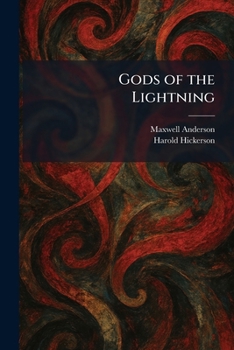
Gods of the Lightning

Select Format
Select Condition 
Book Overview
"Gods of the Lightning" is a powerful and provocative stage drama that addresses the themes of legal corruption and social prejudice. Written by Maxwell Anderson and Harold Hickerson, the play is a fictionalized account inspired by the infamous Sacco and Vanzetti trial, which captivated and divided American society in the 1920s. The narrative follows the plight of two men, Macready and Capraro, who find themselves caught in the gears of a judicial system more interested in political silencing than impartial justice.
The work serves as a searing critique of the Red Scare era, highlighting the tensions between radical political beliefs and the established order. Through sharp dialogue and intense courtroom scenes, "Gods of the Lightning" explores the fragility of civil liberties and the devastating impact of judicial bias. It remains a significant work in the history of American political theater, representing an early and bold attempt to use the stage as a platform for social commentary and the defense of the marginalized. This play is essential for those interested in the intersection of law, politics, and the performing arts, capturing a pivotal moment in American history when the courtroom became a battlefield for ideology.
This work has been selected by scholars as being culturally important, and is part of the knowledge base of civilization as we know it. This work was reproduced from the original artifact, and remains as true to the original work as possible. Therefore, you may see the original copyright references, library stamps (as most of these works have been housed in our most important libraries around the world), and other notations in the work.
This work is in the public domain in the United States of America, and possibly other nations. Within the United States, you may freely copy and distribute this work, as no entity (individual or corporate) has a copyright on the body of the work.
As a reproduction of a historical artifact, this work may contain missing or blurred pages, poor pictures, errant marks, etc. Scholars believe, and we concur, that this work is important enough to be preserved, reproduced, and made generally available to the public. We appreciate your support of the preservation process, and thank you for being an important part of keeping this knowledge alive and relevant.
Related Subjects
DramaCustomer Reviews
ThriftBooks® and the ThriftBooks® logo are registered trademarks of Thrift Books Global, LLC
