


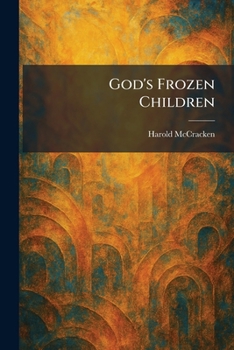
God's Frozen Children

Select Format
Select Condition 
Book Overview
"God's Frozen Children" is a compelling narrative of Arctic exploration and archaeological discovery led by the renowned naturalist and explorer Harold McCracken. Set against the harsh and beautiful backdrop of the Aleutian Islands, the work chronicles a scientific expedition's quest to uncover the secrets of the ancient Aleut people and their unique burial customs. McCracken provides a firsthand account of the challenges faced by explorers in the remote north, detailing the physical hardships and the thrill of unearthing prehistoric mummies preserved in the frozen earth.
The narrative delves into the cultural history and spiritual beliefs of the indigenous populations of the Arctic, offering readers a glimpse into a world largely untouched by modern civilization at the time of the expedition. By blending adventure with anthropological observation, "God's Frozen Children" stands as an important historical document of early 20th-century exploration. It captures the spirit of discovery and the profound respect McCracken held for the ancient inhabitants of the North, making it a valuable read for those interested in archaeology, polar history, and the enduring mysteries of the Arctic.
This work has been selected by scholars as being culturally important, and is part of the knowledge base of civilization as we know it. This work was reproduced from the original artifact, and remains as true to the original work as possible. Therefore, you may see the original copyright references, library stamps (as most of these works have been housed in our most important libraries around the world), and other notations in the work.
This work is in the public domain in the United States of America, and possibly other nations. Within the United States, you may freely copy and distribute this work, as no entity (individual or corporate) has a copyright on the body of the work.
As a reproduction of a historical artifact, this work may contain missing or blurred pages, poor pictures, errant marks, etc. Scholars believe, and we concur, that this work is important enough to be preserved, reproduced, and made generally available to the public. We appreciate your support of the preservation process, and thank you for being an important part of keeping this knowledge alive and relevant.
Customer Reviews
ThriftBooks ® and the ThriftBooks ® logo are registered trademarks of Thrift Books Global, LLC
