


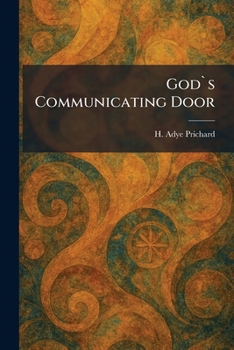
God`s Communicating Door

"God's Communicating Door" is an insightful exploration into the profound mysteries of the afterlife and the spiritual connection between the living and the departed. Written from a deeply thoughtful Christian perspective, this work delves into the possibility of communication with those who have passed beyond the veil, examining the nature of immortality and the soul's journey.
H. Adye Prichard addresses the universal human longing to understand what lies beyond death, offering a bridge between traditional religious faith and the inquiry into psychical phenomena. Through theological reflection and spiritual observation, the book argues for a continuous existence where the "door" between worlds remains ajar. It serves as both a comforting guide for the bereaved and a scholarly investigation into the spiritual dimensions of human existence.
This work remains a significant contribution to early 20th-century literature on spiritualism and Christian eschatology, providing readers with a hopeful vision of eternal life and the enduring bonds of love that transcend physical mortality.
This work has been selected by scholars as being culturally important, and is part of the knowledge base of civilization as we know it. This work was reproduced from the original artifact, and remains as true to the original work as possible. Therefore, you may see the original copyright references, library stamps (as most of these works have been housed in our most important libraries around the world), and other notations in the work.
This work is in the public domain in the United States of America, and possibly other nations. Within the United States, you may freely copy and distribute this work, as no entity (individual or corporate) has a copyright on the body of the work.
As a reproduction of a historical artifact, this work may contain missing or blurred pages, poor pictures, errant marks, etc. Scholars believe, and we concur, that this work is important enough to be preserved, reproduced, and made generally available to the public. We appreciate your support of the preservation process, and thank you for being an important part of keeping this knowledge alive and relevant.
Customer Reviews
ThriftBooks ® and the ThriftBooks ® logo are registered trademarks of Thrift Books Global, LLC
