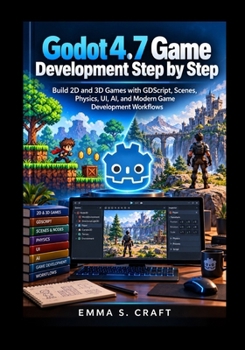
Godot 4.7 Game Development Step by Step: Build 2D and 3D Games with GDScript, Scenes, Physics, UI, AI, and Modern Game Development Workflows

Godot 4.7 is a free and open-source game engine for creating both 2D and 3D games. It brings together scenes, nodes, GDScript, physics, animation, UI, audio, navigation, AI-related systems, debugging, optimization, and project export in one development environment. This book shows you how these tools fit together to create organized, playable games.
You do not need to master the entire Godot engine before you start building. This practical guide focuses on the concepts and workflows that matter when developing real game projects. Instead of overwhelming you with disconnected features or unnecessary theory, it explains how Godot's systems work together and how to apply them as your projects become more advanced.
Godot 4.7 Game Development Step by Step takes you from the foundations of Godot to complete 2D and 3D game development. You will learn how projects, scenes, nodes, scripts, assets, and game logic connect, then progressively build gameplay systems using GDScript.
The book moves from fundamentals into practical game development, covering player movement, collision and physics, reusable scenes, level design, cameras, animation, audio, HUDs, menus, game states, enemy AI, detection, targeting, navigation, pathfinding, 3D environments, interactive objects, combat, and player feedback.
What's Inside
- Godot 4.7 project structure, scenes, nodes, and scene trees
- GDScript fundamentals and gameplay programming
- 2D player controllers, environments, physics, and interactions
- Complete 2D gameplay systems and level progression
- Responsive UI, HUDs, menus, settings, and game states
- Enemy AI, state-based behavior, detection, targeting, and pursuit
- Navigation and pathfinding for smarter movement
- 3D scenes, transformations, meshes, materials, lighting, and cameras
- 3D player movement, physics, interaction, enemies, and gameplay
- Reusable components, resources, signals, groups, and scalable project organization
- Debugging, testing, performance optimization, exporting, and publishing workflows
Designed for beginners, aspiring game developers, indie developers, hobbyists, and programmers who want a practical introduction to Godot game development. It also provides a structured reference for developers moving from basic prototypes toward more organized 2D and 3D projects.
Learn progressively instead of trying to understand everything at once. Each chapter builds on the previous one, helping you move from your first Godot project and basic gameplay concepts toward complete, testable, maintainable game projects.
If you are ready to move beyond watching tutorials and start understanding how real Godot projects are structured, this book gives you a practical path from idea to
Customer Reviews
ThriftBooks ® and the ThriftBooks ® logo are registered trademarks of Thrift Books Global, LLC