


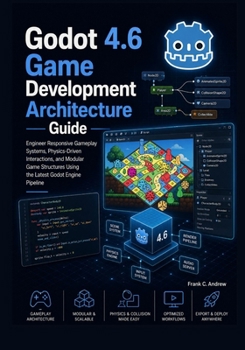
Godot 4.6 Game Development Architecture Guide: Engineer Responsive Gameplay Systems, Physics-Driven Interactions, and Modular Game Structures Using th

Godot 4.6 Game Development Architecture Guide
Engineer Responsive Gameplay Systems, Physics-Driven Interactions, and Modular Game Structures Using the Latest Godot Engine Pipeline
Most game development projects don't fail because developers lack ideas or coding skills-they fail because of weak architecture. Movement systems start breaking when new features are added, physics interactions become inconsistent, AI logic turns messy, and scenes become difficult to scale or reuse. What begins as a functional prototype gradually becomes fragile, unmaintainable, and hard to expand.
The core issue is not programming-it is system design.
This book focuses on solving that problem by teaching you how to build structured, scalable, and production-ready game architecture using Godot 4.6. Instead of isolating mechanics into disconnected tutorials, it shows you how to design complete gameplay systems where movement, physics, AI, UI, and progression all function as part of a unified architecture.
You will learn how to engineer responsive player movement systems that feel consistent under real gameplay conditions, how to design physics-driven interactions that remain stable and predictable, and how to structure AI systems using clean, modular state-based design. It also covers scene architecture, event-driven communication using Godot signals, and performance-aware design practices that ensure your game remains stable as complexity increases.
Beyond individual mechanics, the real value of this book is in how it trains you to think. You will begin to understand how professional games are structured as systems rather than scripts, where every feature is designed to connect cleanly with others without breaking existing logic. This shift in thinking is what separates hobby-level development from professional game engineering.
By the end of this guide, you will be able to build games that are easier to scale, optimize, debug, and extend. Whether you are developing indie games or aiming for industry-level production quality, this book provides the architectural foundation needed to build games that remain stable under real development pressure.
Stop building disconnected features. Start building structured game systems in Godot 4.6.
Customer Reviews
ThriftBooks ® and the ThriftBooks ® logo are registered trademarks of Thrift Books Global, LLC
