


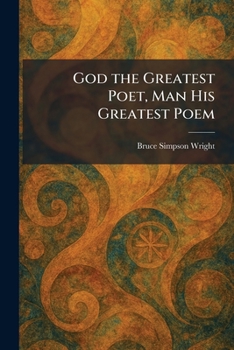
God the Greatest Poet, Man His Greatest Poem

Select Format
Select Condition 
Book Overview
"God the Greatest Poet, Man His Greatest Poem" is an inspiring and lyrical exploration of the spiritual connection between the Creator and humanity. Written by the noted minister Bruce S. Wright, this work presents a series of meditations that frame the divine as an ultimate artist and every human soul as a unique masterpiece of poetic expression. Through engaging prose and profound insights, Wright examines the beauty of faith, the purpose of existence, and the rhythmic grace found within a life lived in harmony with the divine will.
The book invites readers to view their own lives through a lens of creative intent, suggesting that every experience, struggle, and joy is a verse in a larger celestial composition. Ideal for those seeking spiritual enrichment and a deeper understanding of Christian devotion, "God the Greatest Poet, Man His Greatest Poem" remains a timeless testament to the dignity of the human spirit and the boundless imagination of the Almighty. It serves as both a devotional guide and a philosophical reflection on the artistry inherent in the relationship between God and man.
This work has been selected by scholars as being culturally important, and is part of the knowledge base of civilization as we know it. This work was reproduced from the original artifact, and remains as true to the original work as possible. Therefore, you may see the original copyright references, library stamps (as most of these works have been housed in our most important libraries around the world), and other notations in the work.
This work is in the public domain in the United States of America, and possibly other nations. Within the United States, you may freely copy and distribute this work, as no entity (individual or corporate) has a copyright on the body of the work.
As a reproduction of a historical artifact, this work may contain missing or blurred pages, poor pictures, errant marks, etc. Scholars believe, and we concur, that this work is important enough to be preserved, reproduced, and made generally available to the public. We appreciate your support of the preservation process, and thank you for being an important part of keeping this knowledge alive and relevant.
Customer Reviews
ThriftBooks ® and the ThriftBooks ® logo are registered trademarks of Thrift Books Global, LLC
