


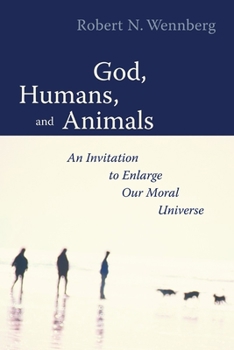
God, Humans, and Animals: An Invitation to Enlarge Our Moral Universe

Select Format
Select Condition 
Book Overview
This is a book about animals and the moral life. The kinds of questions it raises are profound and consequential: Do animals have moral standing? Do human beings have moral obligations to animals? If so, how extensive and weighty are those obligations? Robert Wennberg finds it troubling that society at large seems to care more about such concerns than the Christian community does, and he invites people of faith not only to think more deeply about ethical concerns for animals but also to enter into a richer, more sensitive moral life in general. Over the course of his thought-provoking discussion, Wennberg educates readers about some of the history of ethical concern for animals and the nature of that concern. He also invites serious reflection on the moral issues raised by the existence of animals in our world, while granting readers considerable latitude in reaching their own conclusions. Wennberg arrives at his own conclusions through careful interaction with church history, Christian theology, the Jewish and Christian Scriptures, and the best philosophical thought on the moral status of animals. Two compelling case studies -- of factory farming and painful animal research are also included. All in all, God, Humans, and Animals offers a complete, balanced, and convincing argument for the moral recognition of animals. Most readers will be challenged -- and some may be changed -- by this provocative study.
Format:Paperback
Language:English
ISBN:0802839754
ISBN13:9780802839756
Release Date:December 2002
Publisher:William B. Eerdmans Publishing Company
Length:384 Pages
Weight:1.29 lbs.
Dimensions:0.8" x 6.1" x 9.4"
Customer Reviews
1 rating
If I could talk to the animals...
Published by Thriftbooks.com User , 20 years ago
This is a book with a broad range of purposes. It goes through the long history of considerations of the way in which animals and humans have interacted. What is ethical when it comes to how we regard animals? How are we called to think about these issues? What does church history, and the scriptures (both Jewish and Christian), and the philosophical traditions of our culture have to say about the topic? Robert Wennberg addresses each of these questions in great detail. This is both a scholarly text examining the issues in depth, as well as a persuasive document intended not simply to win the reader over to Wennberg's idea of what ethical treatment is, but rather to get the reader to think in direct ways about the issues. According to Wennberg, the conversation over ethical treatment of animals was stopped by Augustine, whose philosophical idea that only human beings were the appropriate objects of direct moral concern. In the last generation, concern over animals has grown together with an increasing consciousness about the environment and planetary stewardship. What the parameters of this kind of stewardship is remains debatable, but at least the conversation is going in earnest. At the moment, according to Wennberg, the Christian community lags behind the secular community in its consideration of this topic. Is this because of a simplistic reading of passages from Genesis, in which God gives to humanity 'dominion' - often regarded as absolute power? Wennberg argues that Christians should be natural leaders in this conversation, arguing for moral grounds through the doctrine of creation -- animals are part of God's design, not just accidental, and thus should be accorded honour in that recognition. They were declared 'good' in the creation story, and humanity should respect that proclamation. Wennberg addresses such subtopics as the contrast between animal advocacy and environmentalism (which share many key points but are not simple overlapping areas of concern), objectification and subjectivity (borrowing from feminist theory ideas), philosophical ideas from Aquinas and Kant to modern thinkers, concerns in industrial farming and scientific/product testing, and particular scriptural issues. Wennberg has a deep respect for animals and the world in which they (and we) live; he confesses in the early portion of the text that he is still in process of finding the boundaries. That animals have a right to ethical treatment is beyond question for him (putting him at odds with thinkers who see animals as 'soulless' or 'beyond moral approrpriateness'), but just what this kind of ethical treatment requires is still a matter for discussion. Does it require us all to be vegetarians? Does it permit testing for medical purposes, but not cosmetic purposes? And, an area often overlooked, what do we as moral agents do with regard to animal cruelty toward each other? When a mother bird pushes a baby bird out of the nest, what is our res
Copyright © 2026 Thriftbooks.com Terms of Use
| Privacy Policy | Do Not
Sell/Share My Personal Information | Cookie Policy | Cookie Preferences | Accessibility Statement
ThriftBooks® and the ThriftBooks® logo are registered trademarks of Thrift Books Global, LLC
ThriftBooks® and the ThriftBooks® logo are registered trademarks of Thrift Books Global, LLC
