


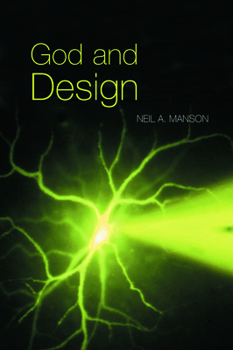
God and Design: The Teleological Argument and Modern Science


Select Format
Select Condition 
Book Overview
Recent discoveries have made the theory that God created the world according to a plan the object of renewed interest. This introduction includes new perspectives, from prominent scientists and philosophers.
Format:Paperback
Language:English
ISBN:0415263441
ISBN13:9780415263443
Release Date:January 2003
Publisher:Routledge
Length:400 Pages
Weight:1.31 lbs.
Dimensions:0.9" x 6.4" x 9.1"
Customer Reviews
3 ratings
Great Articles on a Fascinating Topic
Published by Thriftbooks.com User , 19 years ago
In God and Design, Neil A. Manson has gathered a group of intellectually stimulating articles pertaining to the Argument from Design. The collection includes articles supportive and critical of both local design arguments (i.e., Michael Behe's irreducible complexity) and global design arguments (i.e., the fine-tuned laws which govern the universe). Thankfully, the representation is quite fair, and authors on both sides of the debate get a fair chance. However, global design arguments seem to be the main topic of the debate. For a fuller treatment of the controversial Intelligent Design movement, other works should be pursued. As for the fine-tuning argument, Robin Collins adds a useful discussion of some "solid cases of fine-tuning"- thus overturning the claim that the probability figures for fine-tuning are pulled out of thin air. William Lane Craig successfully lays out the argument and discusses several objections in his paper. Jan Narveson objects to the explanatory power of theism, but his arguments seem to be unconvincing and are also addressed effectively by Richard Swinburne in his paper. The major criticisms of the fine-tuning argument found in the papers, however, have to do with the methods of probability used in supporting the inference to design. Eliot Sober and the Mcgrews/Vestrup argue that there is no basis for probabilities when concerning fundamental constants of nature. However, Collins in particular has elsewhere developed a `rigorous' definition of fine-tuning, thus overcoming this particular objection, in my view. Once the validity of probability judgments are granted, it seems to me that the case for design is compelling.
Rigorous introduction to the cosmological design argument
Published by Thriftbooks.com User , 19 years ago
If the basic laws of physics were even slightly different, intelligent life would be impossible. For example, if gravity were slightly weaker then all stars would be blue giants and a life permitting star like our own would be impossible. But if gravity were slightly stronger then all stars would be red dwarfs and life would be impossible. This is one of many improbably coincidences that seem to lead to the conclusion that life is only possible because of the work of an intelligent designer. 'God and Design' is a balanced book that includes essays from top scientists and philosophers from both sides of the debate. I would strongly recommend it to anyone who is not interesting in a fair hearing from both sides rather than "preaching to the choir." Eliot Sober has a strong article defending the weak anthropic principle, which holds that we are only capable of observing a universe that is compatible with our existence. The principle is correct as far as it goes, but it is too limited to explain our surprise at the improbable nature of a life permitting universe. The philosopher John Leslie has a clever thought experiment that illustrates the weakness of the weak anthropic principle. Imagine you faced a firing squad of 100 men and you lived through it unharmed. You wouldn't invoke the weak anthropic principle and claim that they all must have accidentally missed, you would instead suspect that there is some deliberate plan (design). This has led most atheists to posit the existence of billions upon billions of alternate universes - see Martin Rees' essay for a representative example. Elliot Sober does not give up so easily. He defends the weak anthropic principle on the basis of likelihood analysis, rather than the standard Bayesian analysis preferred by most philosophers. The likelihood principle only focuses on the probability of getting a certain result - in this case a life permitting universe - given that a theory is true. When paired with the weak anthropic principle the likelihood of a life permitting universe is just as good with chance as with design. The problem with likelihood analysis is that it seems to lead to absurd conclusions, such as the prisoner deciding that the firing squad accidently missed. This seems unreasonable, and indeed Sober backs off from that conclusion. In the case of the firing squad we do have the ability to assign meaningful prior probabilities - firing squads are a really good way to kill someone. But Sober claims that we can't make any reasonable claim about the prior probability of the universe supporting life. In this way, Sober parts company from other atheists such as Martin Rees, who do feel a need to directly grapple with and ultimately explain the apparent fine tuning. If Darwin had felt the same way as Sober, he would never have needed to find an explanation for the origin of species. He could have fallen back on the likelihood principle and chance. Martin Rees was impressed by the firing squad analogy
Modern and Comprehensive
Published by Thriftbooks.com User , 22 years ago
Teleological arguments are arguments for the existence of God from (apparent) design in the natural world. The arguments went out of fashion for a while after criticism by Hume and Kant, and especially after Darwin's theory of evolution which attempts to explain how complex, goal directed biological systems may have developed via random genetic mutations over generations without any intervention by a divine designer. But with astonishing breakthroughs in such fields as cosmology and biochemistry, teleological arguments have been reformulated in many different, sophisticated and powerful forms. This anthology of articles by prominent analytic philosophers, physicists and biologists examines some of these arguments. The book begins with Manson's introduction to, and very clear outline of, the subsequent discussion; then the first section discusses some general (and important) considerations about the arguments and includes some excellent and clear material by Swinburne and Sober, among others (but I didn't like the article by Narveson). The second section focuses on teleological arguments from physical cosmology - the apparent fine-tuning of various cosmological constants and conditions of our universe for life - with excellent material by Davies, Craig, Collins and McGrew. The third section explores one putative way to avoid inferring a designer from such fine-tuning by introducing the existence of many universes (If there are many universes with different conditions, then the probability that one might turn out life-permitting might not be so low). The debate here is very interesting, and an article by White, in my opinion, original. The fourth section debates the putative evidence of intelligent design in biological organisms. Behe describes putative "irreducible complexity", which is claimed a major difficulty for unguided (neo)Darwinian evolution. An article by Miller responds to Behe's claim, with interesting diagrams. This section ends with a very insightful article by Van Inwagen on the compatibility of Darwin and design. There are also other articles in this section - as well as in others - which I haven't referred to. So there's alot of material in Manson's book, and it's modern and comprehensive, covering some of the most important developments in many areas. (Some discussion of Plantinga's important argument against evolutionary naturalism would've been much appreciated, though maybe it is excluded since it isn't of an evidential scientific character, being more purely "philosophical" - not to imply that the rest of the material in the book doesn't involve keen, clear philosophical analysis and argument.) The arguments are also of different levels of sophistication- some sections are much more difficult than others. This anthology should, therefore, attract a large audience, from beginners to professional philosophers, physicists and biologists, who have an interest in the current debate.
Copyright © 2026 Thriftbooks.com
Terms of Use | Privacy Policy | Do Not Sell/Share My Personal Information | Cookie Notice | Cookie Preferences | Accessibility Statement
ThriftBooks ® and the ThriftBooks ® logo are registered trademarks of Thrift Books Global, LLC
ThriftBooks ® and the ThriftBooks ® logo are registered trademarks of Thrift Books Global, LLC
