


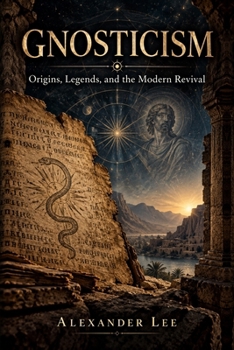
GNOSTICISM: Origins, Legends, and the Modern Revival

What if the world is not what it seems? What if its flaws are not part of a divine plan, but evidence that something went wrong at the beginning?
Nearly two thousand years ago, a diverse group of religious thinkers offered a radical answer. They described an unknowable God beyond the visible cosmos, a lesser creator who mistook himself for the highest power, a divine element trapped within humanity, and salvation through gnosis: knowledge of who we really are and where we came from.
But how much of what we call "Gnosticism" actually comes from the ancient Gnostics themselves?
Gnosticism: Origins, Legends, and the Modern Revival follows the evidence from the earliest surviving accounts to the rediscovery of long lost manuscripts and the extraordinary return of Gnostic ideas in the modern world. Along the way, it separates ancient texts from hostile accusations, later legends, and modern reinterpretations.
The book explores Simon Magus and the origins of the heretical tradition; the discovery of the Nag Hammadi library; Sophia, Yaldabaoth, the demiurge, and the archons; Basilides, Valentinus, Marcion, and other early teachers; competing versions of Jesus and salvation; Irenaeus and the construction of Christian heresy; the Bogomils and Cathars; and the later transformation of Gnostic ideas through William Blake, Theosophy, Carl Jung, Hans Jonas, and Philip K. Dick.
It then follows those ideas into the twenty first century, where ancient language has reappeared in discussions of The Matrix, simulation theory, the "prison planet," reincarnation traps, and online spiritual movements.
Written for readers of history, religion, philosophy, mythology, esotericism, and popular culture, this book does not ask you to believe the Gnostics. It asks a more basic question:
Where did the claim come from?
The result is both a history of Gnosticism and a history of what later generations wanted Gnosticism to be.
Customer Reviews
ThriftBooks ® and the ThriftBooks ® logo are registered trademarks of Thrift Books Global, LLC
