


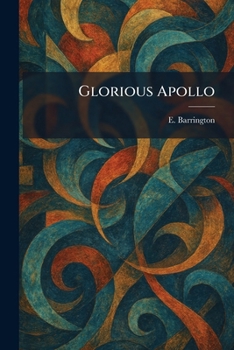
Glorious Apollo

Select Format
Select Condition 
Book Overview
"Glorious Apollo" is a compelling biographical novel that explores the tumultuous and fascinating life of Lord George Gordon Byron, one of the most celebrated and controversial figures of the Romantic era. Written by E. Barrington, the narrative masterfully reconstructs the atmosphere of the early 19th century, exploring the dual nature of a man who was as much a victim of his own passions as he was a literary icon.
The story traces Byron's meteoric rise to poetic fame, his complex and often scandalous relationships, and the societal tensions that shadowed his brilliant career. The work offers a rich exploration of the Regency period, capturing the elegance and the underlying moral conflicts of the time. Through the lens of historical fiction, "Glorious Apollo" presents a vivid portrait of the poet's inner life, his struggles with his public persona, and his enduring impact on the English literary tradition.
Readers are invited to witness the evolution of a genius whose lyrical power defined a generation. This evocative work remains an essential read for those interested in the intersection of biography and fiction, providing deep insight into the heart and mind of the man behind the myth.
This work has been selected by scholars as being culturally important, and is part of the knowledge base of civilization as we know it. This work was reproduced from the original artifact, and remains as true to the original work as possible. Therefore, you may see the original copyright references, library stamps (as most of these works have been housed in our most important libraries around the world), and other notations in the work.
This work is in the public domain in the United States of America, and possibly other nations. Within the United States, you may freely copy and distribute this work, as no entity (individual or corporate) has a copyright on the body of the work.
As a reproduction of a historical artifact, this work may contain missing or blurred pages, poor pictures, errant marks, etc. Scholars believe, and we concur, that this work is important enough to be preserved, reproduced, and made generally available to the public. We appreciate your support of the preservation process, and thank you for being an important part of keeping this knowledge alive and relevant.
Customer Reviews
ThriftBooks® and the ThriftBooks® logo are registered trademarks of Thrift Books Global, LLC
