


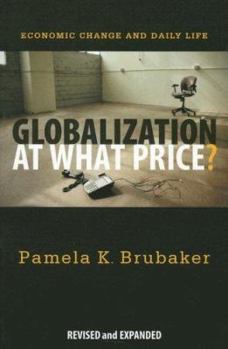
Globalization at What Price?: Economic Change and Daily Life


Select Format
Select Condition 
Book Overview
No Synopsis Available.
Format:Paperback
Language:English
ISBN:0829817654
ISBN13:9780829817652
Release Date:January 2007
Publisher:Pilgrim Press
Length:176 Pages
Weight:0.60 lbs.
Dimensions:0.5" x 5.9" x 8.0"
Customer Reviews
3 ratings
Very useful introduction to globalization and its effects
Published by Thriftbooks.com User , 18 years ago
For those who want a basic understanding of what globalization is, how it effects the daily lives of many people around the world, how the Christian faith offers a perspective on the issues surrounding globalization and what we can do to resist its harmful nature, Pamela Brubaker's book is a very good place to start. She offers chapters on each of these topics and encouragement in a final chapter that our efforts on behalf of those marginalized by globalization can make a significant difference. The introductory chapter on globalism helps the reader make sense of the alphabet soup of organizations, trade agreements and other common terms that are used in discussions of the global economy. Brubaker characterizes, accurately I think, the capitalist nature of economic and political globalization describing how transnational corporations (TNCs) have come to have power over capital used to provide goods and services in many different countries. Their pursuit of profit for its own sake has made the world into a global labor pool in which TNCs can bid for the cheapest labor, often in complete disregard for the health and welfare of the laborers. Brubaker helpfully describes the history of globalization and defines its driving philosophy as "neoliberalism" which advocates the removal of all government restraint on international commerce and economic affairs. Though globalization is sold to the public and politicians as being good for everyone, in reality some players are more powerful than others and its dominating institutions are "continuously altering the rules of the game so as to redistribute income and power upwards." Globalization has become "a means of moving economic decision-making away from elected bodies such as congresses and parliaments, and placing more authority in the hands of unelected, unaccountable institutions such as the IMF, NAFTA or the transnational corporations themselves.". The profits of "free trade" end up in the hands of a minority of powerful investors while the majority of the people are excluded from its benefits. Brubaker documents the way the lives of laborers in the poorer countries have been made worse by the way the global economy is structured. Because cheap labor around the world is plentiful and TNCs can move their production facilities around the globe at will, laborers are not paid a living wage, working conditions are dangerous and they can't afford to buy the goods they make or food they help produce. Brubaker argues that the problems are systemic: "There are no individual solutions. As long as capital and transnational corporations are free to roam the globe in search of cheap labor and lax labor and environmental laws, we are caught up in a 'race to the bottom'." The remedy to ill effects of globalization must be focused on changing the rules, not on addressing symptoms of the problem. In her attempt to connect an oppositional stance to the dominant forces of globalization with the Christi
An Excellent Brief But Complete Description of Globalization
Published by Thriftbooks.com User , 22 years ago
If you are looking for a quick introduction to the issues of globalization this is the book for you. Brubaker clearly and succinctly demystifies this complex phenomenon.She also describes ethical issues circling the many problems of resource distribution, the environment, and national sovereignty. She writes from the perspective of a Christian ethicist but anyone will profit from her discussion.
Great little, critical book on globalization
Published by Thriftbooks.com User , 23 years ago
This is an excellent book for anyone who wants to catch up quickly on what motivated the 1999 WTO demonstrations in Seattle, WA. Brubaker explains what the World Bank, IMF, and World Trade Organization are, and their effects on the developing world -- from injustices in the maquiladoras at the U.S.-Mexican border to Wal-Mart subcontractors in China. Her critical analysis of the excess power wielded by corporate interests is inspired by her humanitarianism, feminism, environmentalism, and Christian faith. This work contains not just a diagnosis of the problems, but activist solutions, even feasible for the uninitiated. There are some heavier duty books on the topic which offer more painstaking treatment of the structure of the global economic institutions and issues; but many of those are not what the intelligent, yet common reader is looking for. This one has the virtue of being an informed, quick read that explains the terrain and leaves us with something to do once we've put the book down. (For the detail-oriented, though, this work is shot-through with footnotes to up-to-the-minute references.)
Copyright © 2026 Thriftbooks.com
Terms of Use | Privacy Policy | Do Not Sell/Share My Personal Information | Cookie Notice | Cookie Preferences | Accessibility Statement
ThriftBooks ® and the ThriftBooks ® logo are registered trademarks of Thrift Books Global, LLC
ThriftBooks ® and the ThriftBooks ® logo are registered trademarks of Thrift Books Global, LLC
