


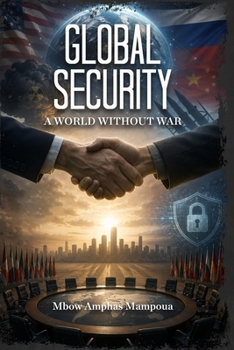
Global Security: A World Without War
No Customer Reviews

This textbook explores modern politics by focusing on how United States power shapes the international system, analyzes the Nuclear Non-Proliferation Treaty (NPT), and highlights transnational security threats like cyberattacks, regional wars, and terrorism that require vital global cooperation. The contemporary international system remains defined by the structural asymmetry of American power, oscillating between the stabilizing capacity of unipolarity and the functional necessity of multilateral collaboration. While structural realists like Kenneth Waltz contend that concentrated power inevitably generates counterbalancing coalitions, the enduring nature of United States primacy suggests a more complex operational reality. Rather than collapsing under the weight of its own preponderance, the post-Cold War order reflects what Samuel P. Huntington conceptualized as a "uni-multipolar" framework-an environment where a singular superpower operates alongside secondary major powers, rendering absolute hegemony unattainable yet sustained decline premature. The collapse of the Soviet Union fundamentally restructured the international arena, leaving the United States with an unprecedented concentration of economic, technological, and military capabilities. Proponents of unipolar stability argue that a dominant power minimizes systemic uncertainty by acting as a global security manager, thereby deterring major power competition and dampening regional conflicts. The magnitude of American military expenditures and technological superiority has raised the costs of counterbalancing to prohibitive levels, obstructing the emergence of a traditional bipolar or multipolar equilibrium. Consequently, the international architecture resists rapid systemic transition, as no singular challenger possesses the comprehensive capacity to displace American primacy. Contemporary American hegemony is mediated by structural interdependencies and transnational imperatives. The United States cannot unilaterally resolve systemic challenges such as nuclear proliferation, regional instability, and transnational terrorism. Effective governance in the twenty-first century necessitates robust bilateral and multilateral security frameworks. By embedding its power within institutional coalitions, Washington seeks to legitimize its strategic objectives and distribute the burdens of global management. This synthesis of dominance and cooperative restraint ultimately dictates that the longevity of American global leadership relies less on coercion than on its capacity to sustain cooperative alliances within an increasingly diffused global order.
Format:Paperback
Language:English
ISBN:B0HKC421FX
ISBN13:9798174641334
Release Date:September 2026
Publisher:Independently Published
Length:458 Pages
Weight:1.34 lbs.
Dimensions:0.9" x 6.0" x 9.0"
Customer Reviews
0 rating
Copyright © 2026 Thriftbooks.com
Terms of Use | Privacy Policy | Do Not Sell/Share My Personal Information | Cookie Notice | Cookie Preferences | Accessibility Statement
ThriftBooks ® and the ThriftBooks ® logo are registered trademarks of Thrift Books Global, LLC
ThriftBooks ® and the ThriftBooks ® logo are registered trademarks of Thrift Books Global, LLC
