


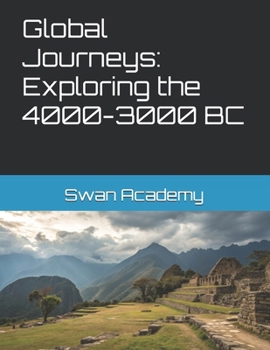
Global Journeys: Exploring the 4000-3000 Century BC
No Customer Reviews

Description of a Hypothetical Educational Workbook: "Global Journeys: Exploring the 4000-3000 BC"
Overview:
This workbook is designed to engage students in the exploration of significant global developments that occurred between 4000 and 3000 BC. This period marks a transformative era in human history, characterized by the rise of early civilizations, technological advancements, and cultural evolution.
Key Features:
Historical Context:
Overview of major civilizations such as Sumer in Mesopotamia, early Egyptian dynasties, and the Indus Valley civilization.Exploration of the Neolithic Revolution and its impact on agriculture and settlement patterns.Technological and Cultural Innovations:
Development of writing systems, including cuneiform and hieroglyphics.Advances in metallurgy, particularly the use of bronze.Early architectural achievements, such as the construction of ziggurats and pyramids.Trade and Interaction:
Examination of early trade routes and the exchange of goods, ideas, and technologies.Role of rivers such as the Nile, Tigris, and Euphrates in facilitating trade and communication.Social Structures and Governance:
Analysis of emerging social hierarchies and political structures.The role of religion and mythology in shaping societal norms and governance.Hands-On Activities:
Interactive maps and timelines to trace the development of early civilizations.Creative projects such as designing a model of an ancient city or writing in an ancient script.Discussion prompts to encourage critical thinking about the causes and effects of historical changes.Assessment and Reflection:
Quizzes and reflection questions to assess understanding and encourage deeper engagement with the material.This workbook aims to provide a comprehensive and engaging look at a pivotal era in human history, fostering a deeper appreciation for the ancient roots of modern civilizations.
Format:Paperback
Language:English
ISBN:B0DYDV9D1X
ISBN13:9798312108033
Release Date:February 2025
Publisher:Independently Published
Length:140 Pages
Weight:0.75 lbs.
Dimensions:0.3" x 8.5" x 11.0"
Customer Reviews
0 rating
Copyright © 2026 Thriftbooks.com Terms of Use
| Privacy Policy | Do Not
Sell/Share My Personal Information | Cookie Policy | Cookie Preferences | Accessibility Statement
ThriftBooks® and the ThriftBooks® logo are registered trademarks of Thrift Books Global, LLC
ThriftBooks® and the ThriftBooks® logo are registered trademarks of Thrift Books Global, LLC
