


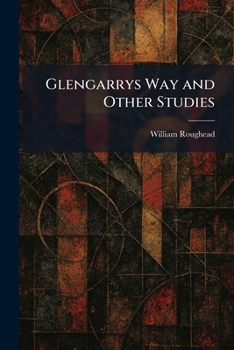
Glengarrys Way and Other Studies

"Glengarry's Way and Other Studies" is a compelling collection of essays by William Roughead, often celebrated as a pioneer of the modern true crime genre. This volume delves into the fascinating and often dark corners of Scottish legal history, offering a series of meticulously researched accounts of criminal trials, legal anomalies, and historical curiosities. Roughead, a lawyer by training, combines a professional's precision with a storyteller's flair to bring to life the complex human dramas found within official records.
The title essay focuses on the volatile and eccentric Alastair Ranaldson Macdonell of Glengarry, whose life and legal entanglements serve as a window into the social and judicial landscape of the Highlands. Beyond this central figure, the collection explores various other "studies" that range from infamous murders to peculiar points of law and forgotten judicial scandals. Through these narratives, Roughead examines the evolution of justice and the enduring mysteries of the criminal mind. This work remains a significant contribution to historical criminology, providing a rich, atmospheric, and highly readable look at the intersection of law, history, and human behavior in Scotland.
This work has been selected by scholars as being culturally important, and is part of the knowledge base of civilization as we know it. This work was reproduced from the original artifact, and remains as true to the original work as possible. Therefore, you may see the original copyright references, library stamps (as most of these works have been housed in our most important libraries around the world), and other notations in the work.
This work is in the public domain in the United States of America, and possibly other nations. Within the United States, you may freely copy and distribute this work, as no entity (individual or corporate) has a copyright on the body of the work.
As a reproduction of a historical artifact, this work may contain missing or blurred pages, poor pictures, errant marks, etc. Scholars believe, and we concur, that this work is important enough to be preserved, reproduced, and made generally available to the public. We appreciate your support of the preservation process, and thank you for being an important part of keeping this knowledge alive and relevant.
Related Subjects
LawCustomer Reviews
ThriftBooks ® and the ThriftBooks ® logo are registered trademarks of Thrift Books Global, LLC
