


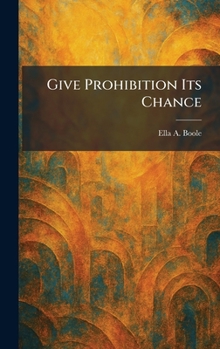
Give Prohibition Its Chance

"Give Prohibition Its Chance" is a compelling and historically significant defense of the Eighteenth Amendment, written during a critical juncture in the American experiment with alcohol prohibition. Authored by Ella A. Boole, the renowned president of the Woman's Christian Temperance Union (WCTU), this work provides a firsthand perspective on the moral, social, and economic arguments that fueled the temperance movement in the United States.
The text delves into the perceived benefits of the prohibition era, with Boole arguing that the restriction of alcohol led to improved public health, greater industrial efficiency, and the protection of the family unit. Addressing the various criticisms and enforcement challenges of the late 1920s, Boole calls for patience and civic duty, urging the nation to allow the law enough time to demonstrate its full potential for social progress. This work serves as an essential primary source for understanding the ideology of social reformers during the Interwar period and the powerful influence of women's political activism in shaping national policy. "Give Prohibition Its Chance" is a fascinating exploration of a transformative era in American law and society, offering deep insight into the debates over personal liberty and the common good.
This work has been selected by scholars as being culturally important, and is part of the knowledge base of civilization as we know it. This work was reproduced from the original artifact, and remains as true to the original work as possible. Therefore, you may see the original copyright references, library stamps (as most of these works have been housed in our most important libraries around the world), and other notations in the work.
This work is in the public domain in the United States of America, and possibly other nations. Within the United States, you may freely copy and distribute this work, as no entity (individual or corporate) has a copyright on the body of the work.
As a reproduction of a historical artifact, this work may contain missing or blurred pages, poor pictures, errant marks, etc. Scholars believe, and we concur, that this work is important enough to be preserved, reproduced, and made generally available to the public. We appreciate your support of the preservation process, and thank you for being an important part of keeping this knowledge alive and relevant.
Related Subjects
History Political Science Politics & Social Sciences Social Science Social SciencesCustomer Reviews
ThriftBooks ® and the ThriftBooks ® logo are registered trademarks of Thrift Books Global, LLC
