


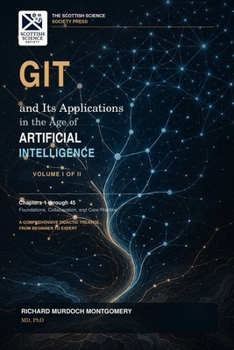
Git: and Its Applications in the Age of Artificial Intelligence VOLUME I OF II
No Customer Reviews

Volume I of II
This book is an attempt to treat a familiar tool with the seriousness it deserves.
Git is used daily by millions, yet it is often learned as a handful of memorised
incantations rather than understood as what it truly is: a principled system for
recording, reconstructing, and bearing witness to the history of a work. My aim
throughout has been to move the reader from the first of these conditions to the
second - from the borrower of commands to the person who understands why
the commands are shaped as they are, and can therefore wield them, extend
them, and reason about them with confidence.
The treatise is long because its subject is broad. It begins with the human
problem that version control exists to solve and builds, chapter by chapter, from
the elementary operations of a single repository to the collaborative workflows
of large teams, the automation of hooks and pipelines, the disciplines of security,
compliance, and privacy, the governance of open-source commons, the
advanced instruments of the expert, the integration of Git with the wider world
of DevOps, containers, and cloud platforms, and finally a set of capstone projects
that put the whole of it to work. A running thread - the idea of version control as
an act of bearing witness - binds these domains together, and the age of
artificial intelligence, in which machines increasingly write and change the
record themselves, gives that thread its present urgency.
A word on how to read it. The chapters are arranged so that each builds on
those before it, and the newcomer is advised to proceed in order; but the later
chapters are self-contained enough that the experienced reader may consult
them singly, as a reference. Each chapter opens with a brief presentation of its
contents, proceeds through ten numbered sections, and closes with worked
examples, exercises, full resolutions, and references for further study. The
detailed table of contents that follows lists every chapter and every section by its
exact number, so that any topic may be found quickly.
This book is Volume I of II. A word on the shape of this edition. The treatise is
issued in two volumes. The present volume, the first, contains Chapters 1
through 45, carrying the reader from the human problem that version control
exists to solve, through the elementary operations of a single repository, the
branching and merging of divergent work, the collaborative workflows of teams,
and the core practices of everyday professional use. The second volume
continues from Chapter 46 onward through the advanced and specialised
material and closes the work with its conclusion and full apparatus. The division
into two volumes is not merely a matter of length: a small number of later
chapters - namely 60, 74, 75, 76, and 77 - are not yet present in the edition,
and fall within the compass of the second volume; issuing the completed first
volume separately allows the finished material to reach the reader without
waiting upon the rest. This first volume is complete and continuous in itself, with
no gaps in its own sequence.
Finally, and most sincerely: this is a large work, and no work of this size is free
of error. I would be very glad indeed if any reader who finds a mistake - whether
of fact, of typography, of command syntax, or of judgement - would write to me
at richard@scottishsciencesociety.org, so that it may be corrected in a future
edition. Any such errors are my own, and mine exclusively; the credit for
whatever is useful here belongs in large part to the many authors and
practitioners on whose work I have drawn, but the fault for whatever is wrong
belongs to me alone. I am grateful in advance to every reader who takes the
trouble to help me set it right.
R. M. M.
S o Paulo, 2026
This book is an attempt to treat a familiar tool with the seriousness it deserves.
Git is used daily by millions, yet it is often learned as a handful of memorised
incantations rather than understood as what it truly is: a principled system for
recording, reconstructing, and bearing witness to the history of a work. My aim
throughout has been to move the reader from the first of these conditions to the
second - from the borrower of commands to the person who understands why
the commands are shaped as they are, and can therefore wield them, extend
them, and reason about them with confidence.
The treatise is long because its subject is broad. It begins with the human
problem that version control exists to solve and builds, chapter by chapter, from
the elementary operations of a single repository to the collaborative workflows
of large teams, the automation of hooks and pipelines, the disciplines of security,
compliance, and privacy, the governance of open-source commons, the
advanced instruments of the expert, the integration of Git with the wider world
of DevOps, containers, and cloud platforms, and finally a set of capstone projects
that put the whole of it to work. A running thread - the idea of version control as
an act of bearing witness - binds these domains together, and the age of
artificial intelligence, in which machines increasingly write and change the
record themselves, gives that thread its present urgency.
A word on how to read it. The chapters are arranged so that each builds on
those before it, and the newcomer is advised to proceed in order; but the later
chapters are self-contained enough that the experienced reader may consult
them singly, as a reference. Each chapter opens with a brief presentation of its
contents, proceeds through ten numbered sections, and closes with worked
examples, exercises, full resolutions, and references for further study. The
detailed table of contents that follows lists every chapter and every section by its
exact number, so that any topic may be found quickly.
This book is Volume I of II. A word on the shape of this edition. The treatise is
issued in two volumes. The present volume, the first, contains Chapters 1
through 45, carrying the reader from the human problem that version control
exists to solve, through the elementary operations of a single repository, the
branching and merging of divergent work, the collaborative workflows of teams,
and the core practices of everyday professional use. The second volume
continues from Chapter 46 onward through the advanced and specialised
material and closes the work with its conclusion and full apparatus. The division
into two volumes is not merely a matter of length: a small number of later
chapters - namely 60, 74, 75, 76, and 77 - are not yet present in the edition,
and fall within the compass of the second volume; issuing the completed first
volume separately allows the finished material to reach the reader without
waiting upon the rest. This first volume is complete and continuous in itself, with
no gaps in its own sequence.
Finally, and most sincerely: this is a large work, and no work of this size is free
of error. I would be very glad indeed if any reader who finds a mistake - whether
of fact, of typography, of command syntax, or of judgement - would write to me
at richard@scottishsciencesociety.org, so that it may be corrected in a future
edition. Any such errors are my own, and mine exclusively; the credit for
whatever is useful here belongs in large part to the many authors and
practitioners on whose work I have drawn, but the fault for whatever is wrong
belongs to me alone. I am grateful in advance to every reader who takes the
trouble to help me set it right.
R. M. M.
S o Paulo, 2026
Format:Paperback
Language:English
ISBN:B0H8TBYYK7
ISBN13:9798187261963
Release Date:July 2026
Publisher:Independently Published
Length:746 Pages
Weight:2.16 lbs.
Dimensions:1.5" x 6.0" x 9.0"
Customer Reviews
0 rating
Copyright © 2026 Thriftbooks.com
Terms of Use | Privacy Policy | Do Not Sell/Share My Personal Information | Cookie Policy | Cookie Preferences | Accessibility Statement
ThriftBooks ® and the ThriftBooks ® logo are registered trademarks of Thrift Books Global, LLC
ThriftBooks ® and the ThriftBooks ® logo are registered trademarks of Thrift Books Global, LLC
