


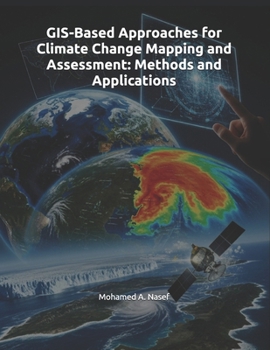
GIS-Based Approaches for Climate Change Mapping and Assessment: Methods and Applications
No Customer Reviews

In recent years, significant efforts have been devoted to understanding climate change, with temperature variability recognized as a key driving factor. As a result, advanced analytical approaches have been developed to examine statistical measures such as means, variances, anomalies, and trends, as well as to assess potential risks. This book explores the application of Geographic Information Systems (GIS) in the analysis of climate change data, highlighting its critical role in addressing environmental challenges and supporting sustainable solutions. By integrating multiple layers of spatial and temporal data, GIS provides powerful tools for understanding complex climate patterns and their underlying drivers. The book presents comprehensive methodologies for mapping and analyzing climate change trends, with a particular focus on temperature dynamics. It demonstrates how GIS can be used to identify key influencing factors and reveal spatial variability over time. Topics covered include climate change concepts, historical evolution and future projections, GIS principles, geostatistical analysis, interpolation techniques, and the spatial-temporal analysis of temperature trends. This work serves as a valuable resource for researchers, students, and professionals in geography, climate science, and spatial analysis.
Format:Paperback
Language:English
ISBN:B0H252D3VT
ISBN13:9798197297808
Release Date:September 2019
Publisher:Independently published
Length:157 Pages
Weight:0.84 lbs.
Dimensions:11.0" x 0.4" x 8.5"
Customer Reviews
0 rating
Copyright © 2026 Thriftbooks.com
Terms of Use | Privacy Policy | Do Not Sell/Share My Personal Information | Cookie Policy | Cookie Preferences | Accessibility Statement
ThriftBooks ® and the ThriftBooks ® logo are registered trademarks of Thrift Books Global, LLC
ThriftBooks ® and the ThriftBooks ® logo are registered trademarks of Thrift Books Global, LLC
