


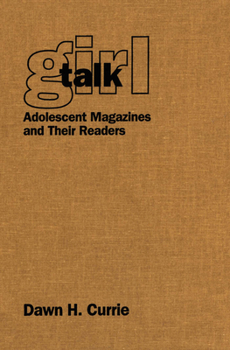
Girl Talk: Adolescent Magazines and Their Readers


Select Format
Select Condition 
Book Overview
Current feminist debate finds itself at an impasse concerning the significance of magazines for adolescent girls- are they full of oppressive prescriptions of femininity, or celebrations of female-centred pleasure and resistance against the patriarchy? The question has been examined largely by middle-aged academics, in some cases far removed in age and education from the intended consumers of these magazines, and the assumptions they have reached about the messages absorbed by young women may be completely wrong. Dawn Currie takes a new approach, by looking at the readers themselves and how they interpret the message of the magazines in their everyday lives. Based on interviews with 48 girls aged 13 to 17, this book challenges many assumptions that have arisen through researchers making their own interpretations, such as the supposed appeal of glossy photo spreads and advertisements. In Currie's study, we find that girls prefer written texts, particularly advice columns, because they view them as useful for everyday living, particularly within the school culture, which Currie finds reinforces the message of the 'teenzines' by encouraging girls to doubt themselves rather than to question the cultural constructs that surround them. Using intertextuality as a reading strategy for materialist feminism, Dawn Currie distinguishes between the 'social' and the 'cultural' and allows us to better understand how power as a quality of social relationships works through the cultural media of fashion and beauty magazines.
Format:Paperback
Language:English
ISBN:0802082173
ISBN13:9780802082176
Release Date:April 1999
Publisher:University of Toronto Press
Length:416 Pages
Weight:1.26 lbs.
Dimensions:1.0" x 6.0" x 9.0"
Grade Range:Postsecondary and higher
Customer Reviews
1 rating
finally
Published by Thriftbooks.com User , 25 years ago
Finally, instead of speculating about the effects of media on teenage girls, someone asked the girls themselves! This book examines the features, advertising, and "advertorials" of magazines aimed at teenage girls AND interviews teenage girls (both magazine readers and non-magazine readers). So, in addition to anazlying content (something that is important and interesting but has been done), Currie speaks to girls to find out how they read the magazines, why they read the magazines, and what they get out of them. The results are surprising. In addition to the interviews and content analysis, Currie also provides information about social research methods that I, someone outside of the sociology field, found very interesting. One complaint about the book is that she used several of the same quotes in more than one section of the book. This repetition made me wonder if the author actually intended for someone to sit down and read the book cover to cover.
Copyright © 2026 Thriftbooks.com Terms of Use
| Privacy Policy | Do Not
Sell/Share My Personal Information | Cookie Policy | Cookie Preferences | Accessibility Statement
ThriftBooks® and the ThriftBooks® logo are registered trademarks of Thrift Books Global, LLC
ThriftBooks® and the ThriftBooks® logo are registered trademarks of Thrift Books Global, LLC
