


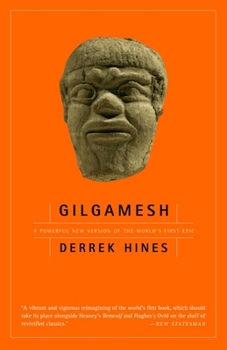
Gilgamesh


Select Format
Select Condition 
Book Overview
The Epic of Gilgamesh is the first great book of man's heart. Inscribed onto clay tablets around 2400 BC, it enthralled the ancient world with a story of love, heroism, friendship, grief and defiance... This description may be from another edition of this product.
Format:Paperback
Language:English
ISBN:1400077338
ISBN13:9781400077335
Release Date:October 2004
Publisher:Anchor Books
Length:80 Pages
Weight:0.90 lbs.
Dimensions:0.2" x 5.3" x 8.1"
Customer Reviews
1 rating
Christopher Logue-esque reworking of Gilgamesh
Published by Thriftbooks.com User , 17 years ago
Derrek Hines does to Gilgamesh what Christopher Logue does to the Iliad in "War Music;" he's rewritten the epic from ground-up in contemporary English verse. The back cover of this edition of Gilgamesh namedrops Ted Hughes's "Tales from Ovid" and Seamus Heaney's "Beowulf" as points of comparison - but those two books were actual translations. Hines's Gilgamesh is not, and neither is Logue's "War Music." The reason Logue isn't mentioned, I assume, is because whole swathes of Hines's Gilgamesh come off like "War Music, Part Two." I mean, it's more Logue than Logue in parts, with its postmodern spin on ancient epic. Here's how Hines writes the intro of the goddess Ishtar, as she descends upon Gilgamesh: The incoming, high-velocity blip on the radar screen flips onto the sky, and cracks the sound barrier. Before him a Manhattan-high wall of glass air shatters, and reglazes behind a woman. For a moment blue's brakes fail: everything stammers sapphire until her eyes cool to human frequencies. She is ISHTAR . . . So Logue is a huge influence here. And though Hines proves himself a fine poet, there is one element where Logue is his superior: Logue remembers to craft a narrative. Hines instead relays the story of Gilgamesh in hindsight, spending more time on extended soliloquies on life and death. The battle with Humbaba for example is here relayed via the POV of an anonymous soldier, complete with high-tech metaphors of the battle. But as for Gilgamesh's actual battle with Humbaba? It's dashed off in four lines - beginning, middle, and end. Gilgamesh's quest for immortality is given even shorter shrift; he gains and loses the "Herb of Immortality" in one single line. It's for these reasons that, as others have stated, this version of Gilgamesh should not serve as one's entry point into the epic. This is certainly written for those who have read more faithful translations of Gilgamesh and are now ready for a snazzier take on it. My only regret is that Hines doesn't spend more time letting the tale unfold. He speeds through every memorable scene - Gilgamesh and Enkidu's first meeting, their battles, Ishtar's proposal to Gilgamesh and Gilgamesh's denial of her, the battle with the Taurus constellation, Enkidu's death, the whole goshdarn STORY, basically - broaching and dismissing them in the blink of an eye. That being said, this book is filled to the brim with poetic moments. Take this fantastic insight: For who needs the gods when you have poetry to exalt and redeem man in his fate - a liturgy without religion? And here is Gilgamesh's recount of his (all-too-briefly told) trip to the Underworld: "And of the Underworld, well, grim it was, but I've seen more terrifying places in a lover's eyes." So even if it isn't as jawdropping as Logue's "War Music" or as flawless as Hughes's "Tales from Ovid," this "account" of Gilgamesh at least reaches for the same heights - and sometimes manages to snatch hold.
Copyright © 2026 Thriftbooks.com
Terms of Use | Privacy Policy | Do Not Sell/Share My Personal Information | Cookie Policy | Cookie Preferences | Accessibility Statement
ThriftBooks ® and the ThriftBooks ® logo are registered trademarks of Thrift Books Global, LLC
ThriftBooks ® and the ThriftBooks ® logo are registered trademarks of Thrift Books Global, LLC
