


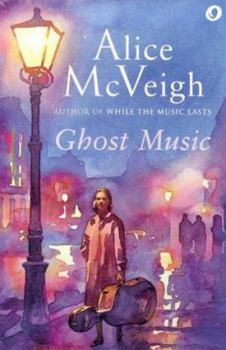
Ghost Music


Select Format
Select Condition 
Book Overview
Alice McVeigh's?second novel set in the world of a symphony orchestra is the story of how two orchestras compete for one source of funding, and how the arrival of a young cellist with a haunted past... This description may be from another edition of this product.
Format:Paperback
Language:English
ISBN:0752809202
ISBN13:9780752809205
Release Date:October 1997
Publisher:Orion Publishing
Length:426 Pages
Weight:0.80 lbs.
Dimensions:7.6" x 1.0" x 5.1"
Customer Reviews
2 ratings
Brava! Brava! Encore! Encore!
Published by Thriftbooks.com User , 20 years ago
It's entirely too bad that awards are not presented in the book industry such as the ones given for recordings or films or videos. Surely, had the opportunity been presented to nominate the best supporting character in a work of fiction, my choice would have to be that of Charmaine McKinley, who appears in chapter forty of Ghost Music by Alice McVeigh. Of course, Miss McKinley has had more years than most of us will ever see in which to perfect herself, but Ms. McVeigh deserves special kudos for gifting us with this wonderful, wizened little person. It's rather obvious that such as she never existed, therefore she had to be created. And she really must be read about in order to be truly appreciated. She quite steals the book away from the other wonderfully crafted characters in this book, many of whom first appeared in "While the Music Lasts", the first book by Ms. McVeigh. This book would not make a very good movie, but it would be a perfectly smashing mini-series, there's that much to it. Where to start? Well, after the above-mentioned Miss McKinley, who only appears briefly mid-book, (pages 218-229) there is the delightful dish on orchestral life. If you are, or know of, a classical musician, you'll love the inside scoop, which is more accurate than most folks would believe. It is, after all, the `unsuitable and the unspeakable united in a doomed attempt at the impossible. And they're never, by definition, as good as they used to be.' (quote from page 214) William Mellor, after many years as cellist of the Orchestra of London has gone over to the Royal Sinfonia, one of the many orchestras resident in London. He needs the change of scene in order to balance his suddenly crumbling life. Or try to. It is, of course, impossible. To begin with, after having been informed of his tryst with Isabel (a young violist) by a snoopy neighbor of the violist, his wife Margot has left him, and returned to her mother's home, wheelchair and all. Margot is struggling with multiple sclerosis, and William's default has made continued life with him untenable for her. The shock of Margot's leaving causes William to entirely break off the relationship with Isabel, who after all, has gone over to the new conductor, Karl Hochler, in her temporary loneliness. Without being aware of exactly what he hath wrought, William had innocently purchased a cello from an auction house. Strange things begin to happen-occasionally-to those in the vicinity of the cello whenever it is played, most notably the conductor of the Sinfonia, Leszek Zemitsky. The appearance of a new trial cellist, Janice, seems somehow connected, which makes no sense at all. Unless once can suspend disbelief to include ghosts. For it does seem as the cello is indeed haunted. The presentation of the story line about the cello and how it interacts with each person with whom it shares any space-close-up or across a concert hall-is breath-taking, and eminently believable. The steady decline of
Instrument carries ghost?
Published by Thriftbooks.com User , 24 years ago
This is an intricately twined, thoroughly engrossing story about cellist William Mellor who buys a second instrument that turns out to have an eerie voice and history. The actual events in the story are revealed subsequently through different character's perspective and actions. As a device, this is not totally effective, since often their voices become indistinct, if not indistinguishable. Still, there's lots of orchestra color, and mystery, and amorous intrigues abound.
Copyright © 2026 Thriftbooks.com Terms of Use
| Privacy Policy | Do Not
Sell/Share My Personal Information | Cookie Policy | Cookie Preferences | Accessibility Statement
ThriftBooks® and the ThriftBooks® logo are registered trademarks of Thrift Books Global, LLC
ThriftBooks® and the ThriftBooks® logo are registered trademarks of Thrift Books Global, LLC
