


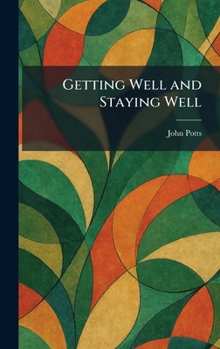
Getting Well and Staying Well

"Getting Well and Staying Well" is an insightful and historical guide to health management and recovery, written during an era when tuberculosis posed a significant threat to global public health. Authored by John Potts, this work emphasizes the critical role of the patient in the healing process and the necessity of personal discipline in maintaining long-term wellness. The book provides a comprehensive look at the medical philosophy of the early 20th century, focusing on rest, nutrition, and psychological fortitude as the essential pillars of recuperation.
Potts goes beyond simple medical advice, addressing the social, physical, and emotional aspects of chronic illness. He offers practical strategies for managing symptoms and preventing relapse, making the work a foundational manual for the principles of preventive medicine. The text serves as a fascinating window into the evolution of modern health practices and the development of patient-centered care. "Getting Well and Staying Well" remains a valuable resource for medical historians, health practitioners, and readers interested in the historical context of self-care and infectious disease management. It highlights a period of transition in medicine where the cooperation between physician and patient became a recognized necessity for successful treatment outcomes.
This work has been selected by scholars as being culturally important, and is part of the knowledge base of civilization as we know it. This work was reproduced from the original artifact, and remains as true to the original work as possible. Therefore, you may see the original copyright references, library stamps (as most of these works have been housed in our most important libraries around the world), and other notations in the work.
This work is in the public domain in the United States of America, and possibly other nations. Within the United States, you may freely copy and distribute this work, as no entity (individual or corporate) has a copyright on the body of the work.
As a reproduction of a historical artifact, this work may contain missing or blurred pages, poor pictures, errant marks, etc. Scholars believe, and we concur, that this work is important enough to be preserved, reproduced, and made generally available to the public. We appreciate your support of the preservation process, and thank you for being an important part of keeping this knowledge alive and relevant.
Customer Reviews
ThriftBooks® and the ThriftBooks® logo are registered trademarks of Thrift Books Global, LLC
