


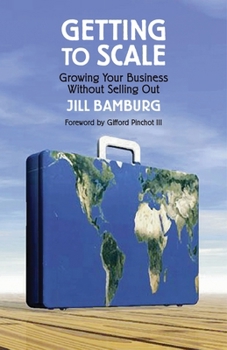
Getting to Scale: Growing Your Business Without Selling Out

Select Format
Select Condition 
Book Overview
Ben & Jerry's. Stonyfield Farm. The Body Shop. Tom's of Maine. All leaders in the socially responsible business movement--and all eventually sold to mega-corporations. Do values-driven businesses have... This description may be from another edition of this product.
Format:Paperback
Language:English
ISBN:1576754162
ISBN13:9781576754160
Release Date:August 2006
Publisher:Berrett-Koehler Publishers
Length:192 Pages
Weight:0.80 lbs.
Dimensions:0.6" x 5.5" x 8.5"
Customer Reviews
5 ratings
Big Doesn't Have to be Evil
Published by Thriftbooks.com User , 17 years ago
Tackling head-on the issue of whether it's possible to grow a socially responsible company into a large enterprise while maintaining the original mission-and addressing the planning failures of companies like Ben & Jerry's, who saw their mission compromised after they sold out-Getting to Scale documents a number of companies that have managed to stay both profitable and responsible while growing, in some cases, to annual revenues in the nine figures. The book even cites examples of how the founding owners can sell the company while ensuring the continuity of a mission driven by more than a purely financial bottom line. Several of these enterprises involve manufacturing or other capital-intensive activities, where economies of scale are directly related to the ability to succeed. And from my perspective as the owner of a one-person business who has deliberately chosen to stay small-and who believes strongly that market share is an irrelevant concept to most microbusinesses-this was a real eye-opener. It was, in fact, quite refreshing to read stories of successful companies that started very modestly-some of them with just a few hundred dollars, ranging up to 6-figure startup costs-companies that had figured out how to build their businesses so that the social mission was so closely entwined with the essential core of business success that it could not be compromised. In keeping with the message of my own book Principled Profit: Marketing That Puts People First, Bamburg not only pays attention to the advantages that socially/environmentally responsible companies have in the marketplace-but also shows how to maintain those advantages while scaling up far beyond the dreams of most socially motivated business owners, but also how to leverage that growth to do greater good in the world. A couple of my favorite quotes; he second is in the context of growing a nonprofit, but I think it applies equally well to social change-oriented for-profit businesses: When the company's value proposition is directly tied to the firm's social value proposition, it becomes a lot easier to make day-to-day business decisions, to avoid values conflicts, and to address the "legacy" issues to ensure that the social values of the firm will outlive the founder's direct involvement. The pieces fit together and reinforce each other in a way that is almost magical. (p. 16) Start something with the low-hanging fruit...Somebody will usually say, "Well, I want to do something and then take it to the hardest place in the world. We're going to go where the need is the biggest. Well, that's great, but...the vast majority of people actually don't live in the very worst places in the world...Find the place where you can actually develop a model and make it work...Then you start saying, "OK, now we can start taking this to slightly harder places." (Martin Fisher, co-founder of KickStart, a nonprofit technology transfer firm working primarily in Africa, p. 130) I'd describe this on
Helpful examples; no perfect answer
Published by Thriftbooks.com User , 19 years ago
First, a caveat. I know the author. I think she is a wonderful person; smart, committed to change, a change maker. With this book she is addressing a key question. One that goes to the heart of capitalism and globalization. If it isn't possible to "scale up" a mission based company without selling out (either the company's ideal, or by a "liquidity event) then we have a real problem, don't we? Unlike the reviewer below, I think that this book goes well with "Small Giants". The subtitle of Small Giants is "How some companies choose to be great, instead of big." It is in the tradition of "Built to Last" and "Good to Great". And let's be frank... none of the companies in either book are Exxon or GM size companies. Of course, while the press focuses on the big guys, the US economy is driven by small business. That is where the growth, innovation and employment is. What is going on in both books is that the authors are providing examples that are important: companies that have a purpose beyond just "maximizing shareholder return." This means the companies need to make some choices, choices that are not always obvious, unless you read these books. When companies grow, they get new stakeholders (employees, investors, customers). Does this growth necessarily dilute mission? Both these books provide some examples. They provide hope. But, until we have a "green" Microsoft or Google, I guess that people can continue to argue. And some folks seem to think business is inherently evil, so no matter how well intentioned, any enterprise will end up having a bad effect. I don't really care if those people read this book. But if these books provide an example that inspire entrepreneurs to not only "Just do it" but "Just do it with purpose" that would be great. Paul Hawken probably didn't expect that his book would inpire Ray Anderson to remake Interface. I hope these books inspire many less famous "remakes" and begin to inspire a number of companies that take these ideas and bring them to new industries and regions of the world. I'd spend the money and read both if you are interested in building a company that has a purpose. That you want to get up every day and work on. And where you feel you will need other's help. One thing is for sure, if you don't have the goal in mind, there are plenty of forces conspiring to dilute your idea. And, as all entrepreneurs know, taking action is hard, and attracts many critics. But building a company can be a positive act of change. Reading this book will help you think through the issues in building a mission based business and scaling it up.
Excellent Case Collection and Synthesis
Published by Thriftbooks.com User , 19 years ago
I think the first reviewer missed the point (or several points) about this book. As the title indicates, the book *is* about "getting to scale" and growing beyond being "small" and "local." While she doesn't at all dismiss small and local businesses, these aren't the focus of her book. Maybe her next one will be, but this one isn't. Any book that is a collection of case studies by definition leaves some examples out (like Whole Foods). Bamburg describes a wide range of companies, and it's impossible to compare them just based on the balance sheet or income statements. She provides the data available to give the reader a sense of the size of the enterprise. Where it's lacking, I'm betting it's because the company may be privately held and unwilling to make this information available. Not unusual at all. "Small Giants" is a great book, and in my opinion, complimentary to Bamburg. In the same way that no company is "pure" from a sustainability point of view, it's not clear to me that 100% local businesses represent the solution to our problems. There are things that I need (and yes, want) that are not produced in my bioregion, and companies that have figured out a least-harmful way to procure these things for me are ones that I will support. And I'm betting many of these are companies that have "gotten to scale" in the way Ms. Bamburg writes. This book isn't a manual, but a collection of example companies that have been successful, grown to a certain level of scale, and have not sacrificed the values and intentions they started out with. Are they perfect? No. Do some of them make things that I don't like? Absolutely. But I learned a lot from Bamburg's excellent book, and I think anyone interested in businesses that are attempting to tread lightly on the planet and treat people with respect and dignity should read it.
How businesses can both have positive impacts and become bigger and more effective.
Published by Thriftbooks.com User , 19 years ago
Written by Jill Bamburg (dean of the MBA program at the Bainbridge Graduation Institute), Getting To Scale: Growing Your Business Without Selling Out draws upon interviews with more than thirty growth-oriented entrepreneurs to deliver readers the straight scoop on what to take into account when deciding just how much one's business should expand. Debunking myths such as "you have to sell out to grow", Getting to Scale addresses how to responsibly increase business size while maintaining ownership and control, how to adapt to corporate culture, how to access greater capital and markets, and much more. Written in plain, no-nonsense terms, Getting To Scale is emphatically recommended for anyone scaling up the size of the business - whether simply opening a second storefront, taking the step to incorporate, or going global.
An Excellent Guideline
Published by Thriftbooks.com User , 19 years ago
There has been a growing interest in socially responsible businesses. Many of them have been started by entrepreneurs who subsequently realized that in order to grow to their maximum potential that they would have to sell out to one of the mega-corporations. There are several reasons for this the most important of which is better access to capital and markets. The small company simply doesn't have the resources to last through a bad turn in the economy or to expand nation or world wide as rapidly as needed. The author is dean of the MBA program at the Bainbridge Graduate Institute which offers programs focused on sustainable business. This is an unusual program since most MBA programs are oriented to train people to work as managers in huge companies. In this book she identifies nine critical issues that must be managed well if a business is to grow yet preserve the independence desired by the founders. Having formed such a business, I can tell you that her ideas are right on. Only that I would add one more factor - luck. You may be doing everything right when Hurricane Katrina comes to visit. All in all, an excellent book.
Copyright © 2026 Thriftbooks.com Terms of Use
| Privacy Policy | Do Not
Sell/Share My Personal Information | Cookie Policy | Cookie Preferences | Accessibility Statement
ThriftBooks® and the ThriftBooks® logo are registered trademarks of Thrift Books Global, LLC
ThriftBooks® and the ThriftBooks® logo are registered trademarks of Thrift Books Global, LLC
