


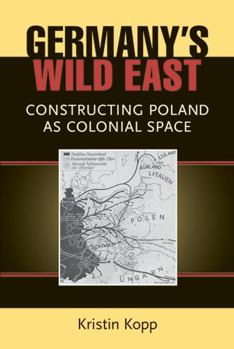
Germany's Wild East: Constructing Poland as Colonial Space
No Customer Reviews

Select Format
Select Condition 
Book Overview
In the 19th and early 20th centuries, representations of Poland and the Slavic East cast the region as a primitive, undeveloped, or empty space inhabited by a population destined to remain uncivilized without the aid of external intervention. These depictions often made direct reference to the American Wild West, portraying the eastern steppes as a boundless plain that needed to be wrested from the hands of unruly natives and spatially ordered into German-administrated units. While conventional definitions locate colonial space overseas, Kristin Kopp argues that it was possible to understand both distant continents and adjacent Eastern Europe as parts of the same global periphery dependent upon Western European civilizing efforts. However, proximity to the source of aid translated to greater benefits for Eastern Europe than for more distant regions.
Format:Hardcover
Language:English
ISBN:0472118447
ISBN13:9780472118441
Release Date:September 2012
Publisher:University of Michigan Press
Length:270 Pages
Weight:1.25 lbs.
Dimensions:1.0" x 6.1" x 9.1"
Customer Reviews
0 rating
Copyright © 2026 Thriftbooks.com Terms of Use
| Privacy Policy | Do Not
Sell/Share My Personal Information | Cookie Policy | Cookie Preferences | Accessibility Statement
ThriftBooks® and the ThriftBooks® logo are registered trademarks of Thrift Books Global, LLC
ThriftBooks® and the ThriftBooks® logo are registered trademarks of Thrift Books Global, LLC
