


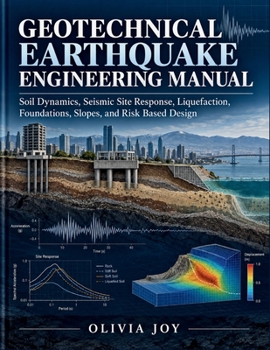
Geotechnical Earthquake Engineering Manual: Soil Dynamics, Seismic Site Response, Liquefaction, Foundations, Slopes, and Risk Based Design

This Book is a comprehensive professional reference designed to connect the science of earthquake ground motion with practical geotechnical analysis, design, and risk-informed engineering decisions. Covering soil dynamics, seismic site response, liquefaction, foundations, slopes, earth-retaining systems, and performance-based design, this manual provides a structured pathway from seismic hazard characterization to engineering evaluation and mitigation.
Rather than treating earthquake engineering as a collection of isolated calculations, the book develops an integrated workflow linking seismic loading, subsurface conditions, dynamic soil behavior, ground deformation, foundation response, structural interaction, and project performance. It explains how ground conditions can amplify or modify shaking, generate excess pore-water pressure, cause settlement and lateral spreading, influence slope stability, and affect critical infrastructure.
Readers are guided through earthquake sources and seismic hazard, wave propagation, dynamic soil properties, laboratory and field testing, seismic site characterization, one- and multidimensional site-response analysis, liquefaction triggering and consequences, cyclic softening, seismic slope stability, retaining and underground structures, shallow and deep foundations, dams, levees, ports, lifelines, ground improvement, and advanced performance-based analysis.
The manual places particular emphasis on engineering judgment, transparent assumptions, uncertainty, sensitivity analysis, verification, and defensible decision-making. Worked methods focus not only on obtaining numerical results but also on understanding their physical meaning, limitations, and appropriate application.
Written for advanced students, geotechnical engineers, structural engineers, engineering geologists, reviewers, and practicing professionals, this book serves as both a detailed learning resource and a practical desk reference for seismic geotechnical work.
For anyone seeking a rigorous, systematic, and application-focused understanding of how soil, foundations, and infrastructure behave during earthquakes, this manual provides a valuable framework for safer and more resilient engineering. CLICK ON ADD TO CART NOW
Related Subjects
Engineering Science Science & Math Science & Scientists Science & Technology TechnologyCustomer Reviews
ThriftBooks ® and the ThriftBooks ® logo are registered trademarks of Thrift Books Global, LLC
