


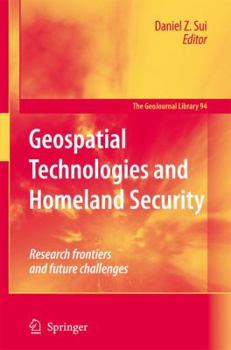
Geospatial Technologies and Homeland Security: Research Frontiers and Future Challenges
No Customer Reviews

Select Format
Select Condition 
Book Overview
Dedication page/Acknowledgement, - Biography of the editor and contributors, - Foreword: Douglas Richardson, - Chapter 1. Geospatial technologies and homeland security: An overview: Daniel Z. Sui, - Chapter 2. Remote sensing and GIS as counterterrorism tools for homeland security: The case of Afghanistan: John (Jack) Shroder, - Chapter 3. Economic impacts of terrorist attacks and natural disasters: Case studies of Los Angles and Houston: Qisheng Pan et al, - Chapter 4. From crime analysis to homeland security: A role for neighborhood profiling?: David I Ashby et al, - Chapter 5. Measuring and mapping conflict-related deaths and segregation: Lessons from the Belfast 'troubles': Victor Mesev et al, - Chapter 6. Internal security for communities: A spatial analysis of the effectiveness of sex offender laws: Douglas F. Wunneburger et al, - Chapter 7. Remote sensing-based damage assessment for homeland security: Anthony M. Filippi, - Chapter 8. Estimating flood damage in Texas using GIS: Predictors, consequences, and policy implications: Samuel D. Brody and Sammy Zahran, - Chapter 9. Agent-based modeling and evacuation planning: F. Benjamin Zhan and Xuwei Chen, - Chapter 10. Building evacuation in emergencies: A review and interpretation of software for simulating pedestrian egress: Christian J.E. Castle and Paul A. Longley, - Chapter 11. High-resolution coastal elevation data: The key to planning for storm surge and sea level rise: Mark Monmonier, - Chapter 12. Remote sensing and GIS applications for precision area-wide pest management: Implications for homeland security: Yanbo Huang et al, - Chapter 13. Spatial epidemiology: Where have we come in 150 years?: Michael Ward, - Chapter 14. The role of geosurveillance and security in the politics of fear: Jeremy W. Crampton, - Chapter 15. Mapping the under-scrutinized: The West German census boycott movement of 1987 and the dangers of information-based Security: Matthew Hannah, - Chapter 16. The Importance of spatial thinking in anuncertain world: Robert S. Bednarz and Sarah W. Bednarz, - Chapter 17. GIS and homeland security education: Creating a better tomorrow in our classrooms today: David McIntye and Andrew Klein, - Chapter 18. Geospatial technologies and homeland security: Challenges and opportunities: Michael F.
Format:Hardcover
Language:English
ISBN:1402083394
ISBN13:9781402083396
Release Date:June 2008
Publisher:Springer
Length:360 Pages
Weight:1.59 lbs.
Dimensions:0.9" x 6.1" x 9.2"
Related Subjects
Engineering Science Science & Math Science & Scientists Science & Technology TechnologyCustomer Reviews
0 rating
Copyright © 2025 Thriftbooks.com
Terms of Use | Privacy Policy | Do Not Sell/Share My Personal Information | Cookie Policy | Cookie Preferences | Accessibility Statement
ThriftBooks ® and the ThriftBooks ® logo are registered trademarks of Thrift Books Global, LLC
ThriftBooks ® and the ThriftBooks ® logo are registered trademarks of Thrift Books Global, LLC
