
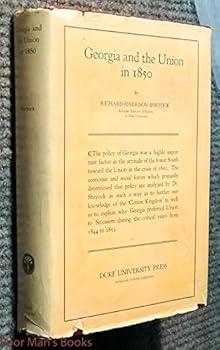
"Georgia and the Union in 1850" provides an in-depth historical analysis of the political climate in Georgia during one of the most tumultuous years in American history. Richard Harrison Shryock examines the state's internal divisions and its shifting relationship with the federal government as the nation grappled with the Compromise of 1850.
The work explores the complex interplay between radical secessionists and conservative Unionists, detailing the debates that shaped Southern identity and political strategy in the decade preceding the Civil War. By focusing on local legislative battles, public sentiment, and the influence of key political figures, Shryock provides a comprehensive look at how Georgia navigated the growing crisis over slavery and states' rights.
This scholarly study serves as a crucial resource for understanding the regional tensions that eventually led to the fracture of the Union. It highlights the pivotal role Georgia played as a bellwether for the deep South, illustrating the fragile balance of power and the evolving ideologies that defined the antebellum era.
This work has been selected by scholars as being culturally important, and is part of the knowledge base of civilization as we know it. This work was reproduced from the original artifact, and remains as true to the original work as possible. Therefore, you may see the original copyright references, library stamps (as most of these works have been housed in our most important libraries around the world), and other notations in the work.
This work is in the public domain in the United States of America, and possibly other nations. Within the United States, you may freely copy and distribute this work, as no entity (individual or corporate) has a copyright on the body of the work.
As a reproduction of a historical artifact, this work may contain missing or blurred pages, poor pictures, errant marks, etc. Scholars believe, and we concur, that this work is important enough to be preserved, reproduced, and made generally available to the public. We appreciate your support of the preservation process, and thank you for being an important part of keeping this knowledge alive and relevant.
Related Subjects
History
