


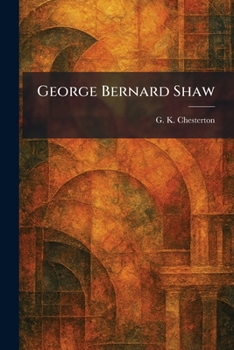
George Bernard Shaw

Select Format
Select Condition 
Book Overview
"George Bernard Shaw" is a brilliant and idiosyncratic critical biography written by G. K. Chesterton, offering a profound exploration of the life, mind, and works of the renowned Irish playwright. Rather than a conventional chronological account, Chesterton provides a thematic analysis that delves into Shaw's Irish heritage, his Puritanical streaks, and his evolution as a social critic and dramatist.
Throughout the work, Chesterton examines Shaw's unique brand of philosophy and his significant impact on the literary and political landscape of the early twentieth century. As a contemporary and intellectual rival, Chesterton brings a unique perspective to the study, balancing admiration for Shaw's wit and intellect with a sharp critique of his worldviews. The book covers Shaw's role as a progressive and a philosopher, dissecting the paradoxes that defined his public persona and his dramatic output.
This volume remains a significant piece of literary criticism, capturing a dialogue between two of the most influential minds of their era. It is an essential read for those interested in the history of modern drama, the development of Fabian socialism, and the enduring legacy of "George Bernard Shaw". Chesterton's prose is as lively and provocative as his subject, making this a foundational text for understanding the Shavian era.
This work has been selected by scholars as being culturally important, and is part of the knowledge base of civilization as we know it. This work was reproduced from the original artifact, and remains as true to the original work as possible. Therefore, you may see the original copyright references, library stamps (as most of these works have been housed in our most important libraries around the world), and other notations in the work.
This work is in the public domain in the United States of America, and possibly other nations. Within the United States, you may freely copy and distribute this work, as no entity (individual or corporate) has a copyright on the body of the work.
As a reproduction of a historical artifact, this work may contain missing or blurred pages, poor pictures, errant marks, etc. Scholars believe, and we concur, that this work is important enough to be preserved, reproduced, and made generally available to the public. We appreciate your support of the preservation process, and thank you for being an important part of keeping this knowledge alive and relevant.
Customer Reviews
ThriftBooks ® and the ThriftBooks ® logo are registered trademarks of Thrift Books Global, LLC
