


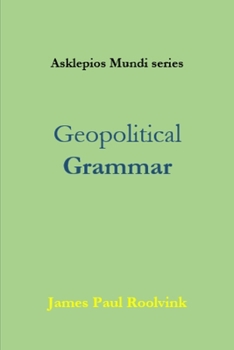
Geopolitical Grammar
No Customer Reviews

This book places geopolitics - the actions of peoples, most of whom are organised into states, state sovereignty - within the realm of the sacred. For it is only within that realm that a concept such as transcendent Power can be understood. Peoples vie for Power, and geopolitics can only be understood on the basis of a 'metaphysical' conception of Power. That is not to say that economic strength and powerful, cunning political influence play no part in explaining what geopolitics is. On the contrary, for the economy determines the degree to which a people is free, and politics determines the degree to which a people possesses freedom - its sovereignty. It is precisely this sovereignty that enables a state to wield supernatural Power or to have the will to acquire that Power. Note, however, that there is a fundamental distinction between worldly power, supernatural Power and transcendent Power. Ethical or moral projections regarding how states and statesmen act lack the realistic insight that it is all about Power. This book aims to teach you to think about geopolitics from an understanding of Power. In doing so, it does not primarily take a stance on geopolitical conflicts, precisely because the focus is on how one can take a stance at all and reflect on geopolitics. It concerns a geopolitical 'vocabulary' of terms (history, sphere of influence, sovereignty, recognition, etc.), which are hierarchically related to one another according to a specific 'grammar'.
The book opens with the question of whether the 'security sphere' - within which a state is permitted to shape its own economic power and foreign policy but not its military power, as determined by another powerful state - should or must form part of the geopolitician's vocabulary. Answering this question reveals the leading schools of thought in Western geopolitics: the realist school and the normative school. The former conceives of geopolitics in Darwinian terms as the survival of the fittest - that is, in terms of power (meaning worldly power) - and is able not only to describe geopolitical reality but also, in many cases, to predict it. The second school approaches geopolitics morally, in terms of how states ought to act, and has no predictive power. Neither the 'right' of the strongest nor morality captures what supernatural Power or transcendent Power is. A large part of the book deals with the sacred as distinct from ethics, morality, beauty, the sublime, virtues and religion, in order to clarify what the sphere of the sacred is, within which only the beginnings of an understanding of transcendent Power are possible. This also makes the book a theological work and an introduction to predictive geopolitics from an eschatological perspective. In this context, knowledge of symbolism is indispensable. Nations are described using highly sophisticated Heideggerian jargon of being, with the ultimate aim of predicting how - and, above all, why - nations will act when they do act, both now and in the future. This book (translated by the translation machine DeepL) also addresses questions such as 'What is the nature of war?', 'How can states recognise each other's sovereignty?', and 'How can a state's power be measured?'. Anyone who wishes to speak meaningfully about geopolitics needs a geopolitical vocabulary and geopolitical grammar. With different words and a different grammar, you can think differently - and better. You can think better because you have more words, just as you can make better music on a piano with 88 keys than with 36, particularly if you are very musical. Without talent, nothing sounds right; you simply cannot make it sound right. A different grammar is a different musical instrument. An instrument where you pluck the strings directly with your fingers, or where there is a single string - your vocal cords - and you can make your own voice sound.
The book opens with the question of whether the 'security sphere' - within which a state is permitted to shape its own economic power and foreign policy but not its military power, as determined by another powerful state - should or must form part of the geopolitician's vocabulary. Answering this question reveals the leading schools of thought in Western geopolitics: the realist school and the normative school. The former conceives of geopolitics in Darwinian terms as the survival of the fittest - that is, in terms of power (meaning worldly power) - and is able not only to describe geopolitical reality but also, in many cases, to predict it. The second school approaches geopolitics morally, in terms of how states ought to act, and has no predictive power. Neither the 'right' of the strongest nor morality captures what supernatural Power or transcendent Power is. A large part of the book deals with the sacred as distinct from ethics, morality, beauty, the sublime, virtues and religion, in order to clarify what the sphere of the sacred is, within which only the beginnings of an understanding of transcendent Power are possible. This also makes the book a theological work and an introduction to predictive geopolitics from an eschatological perspective. In this context, knowledge of symbolism is indispensable. Nations are described using highly sophisticated Heideggerian jargon of being, with the ultimate aim of predicting how - and, above all, why - nations will act when they do act, both now and in the future. This book (translated by the translation machine DeepL) also addresses questions such as 'What is the nature of war?', 'How can states recognise each other's sovereignty?', and 'How can a state's power be measured?'. Anyone who wishes to speak meaningfully about geopolitics needs a geopolitical vocabulary and geopolitical grammar. With different words and a different grammar, you can think differently - and better. You can think better because you have more words, just as you can make better music on a piano with 88 keys than with 36, particularly if you are very musical. Without talent, nothing sounds right; you simply cannot make it sound right. A different grammar is a different musical instrument. An instrument where you pluck the strings directly with your fingers, or where there is a single string - your vocal cords - and you can make your own voice sound.
Format:Paperback
Language:English
ISBN:B0H7XT7XR6
ISBN13:9798186030980
Release Date:July 2026
Publisher:Independently Published
Length:180 Pages
Weight:0.50 lbs.
Dimensions:0.5" x 6.0" x 9.0"
Related Subjects
Philosophy Political Science Politics & Social Sciences Religion Religion & SpiritualityCustomer Reviews
0 rating
Copyright © 2026 Thriftbooks.com
Terms of Use | Privacy Policy | Do Not Sell/Share My Personal Information | Cookie Policy | Cookie Preferences | Accessibility Statement
ThriftBooks ® and the ThriftBooks ® logo are registered trademarks of Thrift Books Global, LLC
ThriftBooks ® and the ThriftBooks ® logo are registered trademarks of Thrift Books Global, LLC
