


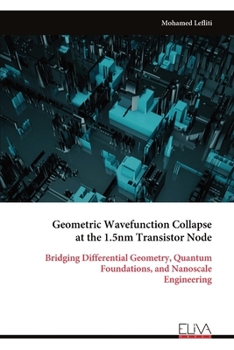
Geometric Wavefunction Collapse at the 1.5nm Transistor Node: Bridging Differential Geometry, Quantum Foundations, and Nanoscale Engineering
No Customer Reviews

### **Conclusion** This book presents a revolutionary new way to understand and design the smallest electronic devices ever made. For decades, engineers built transistors assuming electrons act like tiny, solid particles that stay in one place. This worked well until now - but at the 1.5 nanometer scale, nature changes the rules. Electrons start behaving like waves, spreading out and moving through barriers, making traditional designs fail. Instead of treating these quantum behaviors as a problem to avoid, this work turns them into something we can control. The core discovery is simple but powerful: an electron does not stay in a fuzzy, undefined state forever. It naturally settles into a specific location based on two main factors: its mass and its interaction with the surrounding environment. The main reason transistors fail at this tiny size is not just because they are small, but because the environment no longer clearly tells the electron: *"choose either the source or the drain"*. The electron gets confused and settles into a useless state instead. Based on this insight, clear engineering rules are provided. By breaking symmetry in the design - for example, using different materials or shapes for the gates - we can force the system to choose the correct state every time. We learn how to adjust the device so that the environment itself acts as a reliable switcher, forcing the electron to collapse into the right position fast enough to keep up with computer speeds. This approach solves the biggest puzzle in modern electronics. It explains exactly where the limit of miniaturization comes from, and more importantly, how to overcome it. It proves that we do not have to stop at 1.5 nanometers. By understanding the natural laws of quantum collapse, we can build the next generation of chips, extending Moore's Law further than anyone thought possible. Beyond technology, this work answers a fundamental question of science: why do tiny things follow strange quantum rules, while big things behave normally? It shows that there is no mystery - just a simple relationship between size, speed, and interaction.
Format:Paperback
Language:English
ISBN:9999345913
ISBN13:9789999345910
Release Date:June 2026
Publisher:Eliva Press
Length:68 Pages
Weight:0.23 lbs.
Dimensions:0.1" x 6.0" x 9.0"
Customer Reviews
0 rating
Copyright © 2026 Thriftbooks.com
Terms of Use | Privacy Policy | Do Not Sell/Share My Personal Information | Cookie Notice | Cookie Preferences | Accessibility Statement
ThriftBooks ® and the ThriftBooks ® logo are registered trademarks of Thrift Books Global, LLC
ThriftBooks ® and the ThriftBooks ® logo are registered trademarks of Thrift Books Global, LLC
