


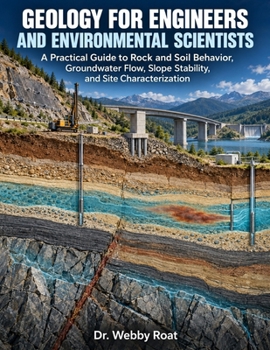
Geology for Engineers and Environmental Scientists: A Practical Guide to Rock and Soil Behavior, Groundwater Flow, Slope Stability, and Site Character

Understand the Ground Beneath Every Engineering Project.
Every structure rests on the Earth, and every environmental challenge begins with understanding the ground beneath our feet. From the stability of a highway cutting to the movement of groundwater through fractured rock, geological conditions influence engineering design, construction safety, environmental protection, and long-term infrastructure performance.
Geology for Engineers and Environmental Scientists provides a comprehensive, practical introduction to the geological principles that shape engineering decisions and environmental investigations. Written by Dr. Webby Roat, this accessible guide connects fundamental earth science concepts with the real-world challenges encountered in civil engineering, geotechnical investigations, groundwater management, and environmental site assessment.
Moving beyond geological theory, the book explores how rocks, soils, geological structures, groundwater systems, and natural processes interact with engineered infrastructure and the surrounding environment. Through clear explanations and an application-oriented approach, readers develop the geological understanding needed to interpret subsurface conditions, recognize potential hazards, and make better-informed technical decisions.
WHAT YOU WILL DISCOVER INSIDEEngineering Geology Fundamentals: Understand the formation, classification, and engineering significance of rocks, minerals, soils, and geological structures.
Rock and Soil Behavior: Explore the physical and mechanical characteristics of geological materials and their influence on foundations, excavations, and construction performance.
Groundwater Flow and Hydrogeology: Examine aquifer systems, hydraulic conductivity, groundwater movement, seepage, and the transport of environmental contaminants.
Slope Stability and Geological Hazards: Understand the mechanisms of landslides, erosion, rockfalls, and slope failures, along with essential concepts for hazard assessment and stabilization.
Site Investigation and Subsurface Characterization: Discover how geological mapping, drilling, borehole logging, sampling, and field investigations contribute to reliable ground interpretation.
Geological Structures and Engineering Implications: Learn how faults, fractures, joints, bedding planes, and weathering affect the strength, permeability, and stability of geological formations.
Environmental Geology and Risk Assessment: Explore the relationship between geological processes, groundwater contamination, land development, natural hazards, and environmental sustainability.
Practical Engineering Applications: Connect geological knowledge to infrastructure planning, foundation assessment, groundwater control, excavation projects, and environmental decision-making.
BRIDGING GEOLOGICAL SCIENCE AND ENGINEERING PRACTICESuccessful engineering and environmental projects depend on more than understanding what lies beneath the surface. They require the ability to recognize geological uncertainty, interpret ground conditions, and anticipate how natural materials will respond to excavation, loading, water movement, and environmental change.
This book develops that essential perspective by connecting geological processes with their practical engineering consequences.
Whether you are studying the behavior of fractured rock, assessing a potentially unstable slope, investigating groundwater conditions, or examining the suitability of a construction site, the underlying geological principles provide a foundation for sound technical judgment.
Customer Reviews
ThriftBooks ® and the ThriftBooks ® logo are registered trademarks of Thrift Books Global, LLC
