


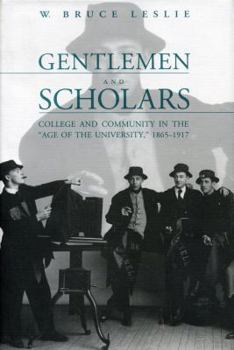
Gentlemen and Scholars: College and Community in the “Age of the University,” 1865–1917
No Customer Reviews

Select Format
Select Condition 
Book Overview
This book provides a new look at the social and cultural roles of the American college after the Civil War. Historians have dubbed the period from the Civil War to World War I "the age of the university," suggesting that colleges were becoming out of touch with American society. Bruce Leslie however challenges this view through case studies of four representative colleges from the Middle Atlantic region--Bucknell, Franklin and Marshall, Princeton, and Swarthmore. Nineteenth-century colleges generally were founded to serve ethnic, denominational, and local interests. After mid-century, however, many were forced to seek financial support from wealthy alumni and urban benefactors, leading to the gradual reorientation of these schools toward an emerging national urban Protestant culture. Colleges therefore found it essential to respond to new currents in American society and higher education. Leslie develops his argument from a close study of faculties, curricula, financial constituencies, student bodies, and campus life.
Format:Hardcover
Language:English
ISBN:0271008296
ISBN13:9780271008295
Release Date:December 1992
Publisher:Penn State University Press
Length:304 Pages
Weight:1.50 lbs.
Dimensions:9.0" x 0.7" x 6.0"
Customer Reviews
0 rating
Copyright © 2025 Thriftbooks.com
Terms of Use | Privacy Policy | Do Not Sell/Share My Personal Information | Cookie Policy | Cookie Preferences | Accessibility Statement
ThriftBooks ® and the ThriftBooks ® logo are registered trademarks of Thrift Books Global, LLC
ThriftBooks ® and the ThriftBooks ® logo are registered trademarks of Thrift Books Global, LLC
