


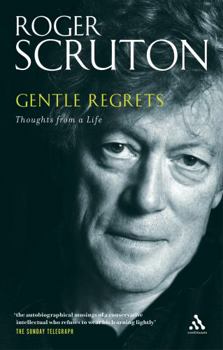
Gentle Regrets: Thoughts from a Life


Select Format
Select Condition 
Book Overview
Roger Scruton is Britain's best known intellectual dissident, who has defended English traditions and English identity against an official culture of denigration. Although his writings on philosophical aesthetics have shown him to be a leading authority in the field, his defence of political conservatism has marked him out in academic circles as public enemy number one. Whether it is Scruton's opinions that get up the nose of his critics, or the wit and erudition with which he expresses them, there is no doubt that their noses are vastly distended by his presence, and constantly on the verge of a collective sneeze. Contrary to orthodox opinion, however, Roger Scruton is a human being, and Gentle Regrets contains the proof of it - a quiet, witty but also serious and moving account of the ways in which life brought him to think what he thinks, and to be what he is. His moving vignettes of his childhood and later influences illuminate this book. Love him or hate him, he will engage you in an argument that is both intellectually stimulating and informed by humour.
Format:Paperback
Language:English
ISBN:0826480330
ISBN13:9780826480330
Release Date:October 2006
Publisher:Continuum
Length:256 Pages
Weight:0.74 lbs.
Dimensions:0.8" x 5.5" x 8.5"
Customer Reviews
3 ratings
A brilliant Thinker
Published by Thriftbooks.com User , 17 years ago
Well, as we all know, Scruton has a very agile intellect, being a dissident in what used to be a very open-minded British society. The trajectory of his life seems to me quite unique. Scruton has challenged the establishment with the power of his conservative ideas AND ideals - and the Brits went on with their bizzare socialist contrivances. Perhaps it would be too much to compare Scruton to Solzhenitsyn, but there is something brave, noble and extraordinary about this solitary knight. He reminds one of Jan Patocka, as well, the brave anti-Communist Czech philosopher who saw his calling to be something far greater than the petty academic achievements... No wonder why Scruton is so well appreciated by the Eastern European public! I only wish he could delve more deeply into the early Christian tradition, for which he certainly shows a lot of respect.
A stimulating traditionalist
Published by Thriftbooks.com User , 18 years ago
One has to be awed by the range of cultural references in this book of autobiographical essays. Coming from a home which was not interested in books, the young Scruton was captivated by Bunyan at the age of 13. At 15 he was into Rilke and Dante. At 16, he and a group of sixth form friends `declared war on kitsch'. By the time he was a Cambridge undergraduate, inspired by T.S.Eliot, he was into Culture in a big way: he and his friends there were `consciously aiming to better themselves', and were establishing hierarchies among works which were not kitsch: the superiority of Mozart over Vivaldi, Milton over Carew, Titian over Veronese, and - Paul McCartney over Mick Jagger. They were elitists, and as such rebels against left wing rebels who were then fashionable. And an individualistic conservative he remained for the rest of his life. As a 24 year old he was in Paris, and witnessed the events of 1968. He was an admirer of De Gaulle because the General defined the French nation in terms of its high culture, and he detested Foucault, one the gurus of the students, for his shallow relativism and for teaching that `truth' requires inverted commas. So he was a defiant fish out of water as a lecturer at Birkbeck College at a time when academia in Britain (unlike in the United States) considered conservatism as an aberration, and when, to find an English conservative philosopher, he had to go back to Edmund Burke. In 1978 Scruton sought a parliamentary seat; but his Burkean philosophy was so unfashionable that he was not selected, and `I ceased to be an intellectual Conservative, and became a conservative intellectual instead'. The chapter called `How I Became a Conservative' is a splendidly vigorous presentation and illustration of his beliefs. For me the finest chapter in the book is the Burkean one on architecture, in which Scruton lambasts modern architecture for its contempt of tradition and for the people on whom it inflicts its soulless and anti-communal monstrosities. Scruton was once Professor of Aesthetics; aestheticism lies at the heart of his conservatism and nowhere does it find more eloquent expression than in this chapter. His hatred of what modern architects have perpetrated was shared by his father, an activist in this respect and whom elsewhere in the book he frequently describes as a foul-tempered tyrant, but who here is given generous filial praise. Conservatives are sceptical of schemes to make the world a better place: and in religion, too, Scruton is attracted by people who believe that `the duty of a Christian is not to leave this world a better place. His duty is to leave this world a better man.' In one chapter he describes two such Christians - both Roman Catholics - who have been very important to him: here we have an aim of self-improvement which is the spiritual equivalent of the aim he has pursued in the cultural realm. The last chapter (which I found went way over the top in its sweeping claims
Perfect Title
Published by Thriftbooks.com User , 18 years ago
Gentle Regrets seems to be the perfect title for this work. Especially strong are his writings regarding religion and the Catholic Church, ironic since he is not Catholic. It is also evident that he has suffered through the years from the liberal establishment that holds university life in a vice, refusing to even hear, let alone consider, reasoned dissent. His writing is as strong as his philosophical thoughts.
Copyright © 2026 Thriftbooks.com Terms of Use
| Privacy Policy | Do Not
Sell/Share My Personal Information | Cookie Policy | Cookie Preferences | Accessibility Statement
ThriftBooks® and the ThriftBooks® logo are registered trademarks of Thrift Books Global, LLC
ThriftBooks® and the ThriftBooks® logo are registered trademarks of Thrift Books Global, LLC
