


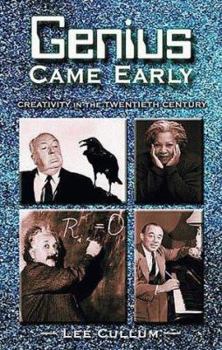
Genius Came Early: Creativity in the Twentieth Century

This book by one of America's most thoughtful journalists explores the great voices of the twentieth century. From Sigmund Freud to Carl Jung, Albert Einstein to James Watson, Pablo Picasso to Mark... This description may be from another edition of this product.
Format:Hardcover
Language:English
ISBN:1881636909
ISBN13:9781881636908
Release Date:November 1999
Publisher:Windsor House Pub Group
Length:383 Pages
Weight:1.58 lbs.
Dimensions:9.0" x 1.5" x 6.0"
Customer Reviews
2 ratings
An Incisive Look at Creativity in the 20th Century
Published by Thriftbooks.com User , 25 years ago
Lee Cullum, who is frequently seen as a popular commentator and analyst on the Lehrer News Hour on PBS, has tackled an almost impossible task--and comes up with a rewarding look at creativity in the 20th Century. Her book gives no easy answers and requires careful reading. But it is a compendium of information which helps us put into some perspective how creativity works. The author gives high marks for creativity in the first part of the century, but is more pessimistic about the creative spark in the century's waning years. This is a book for thoughtful readers. You will find that even when you disagree with the author, you are prodded into thinking and recalling. Hers is a work of interpretation and synthesis across a broad spectrum ranging from the arts to psychology and politics.
A 20th Century Parade
Published by Thriftbooks.com User , 25 years ago
Marshalling a parade of great personalities of the twentiethcentury, Lee Cullum's GENIUS CAME EARLY prepares us for newpossibilities. Saying volumes in so few words, she shows brilliantly how ideas and movements interface, interact and influence one another. An example: "If Picasso, inventor of Cubism who took things apart and put them together again in a new way, can be called Freudian, bound to a masculine response to life, it was Matisse who celebrated woman in the spirit of Jung." Lee Cullum's spiritual insights are profound: "It may be that the saint most antithetical to the twentieth century in its final unfolding is Michael, armed with his sword and the scales of justice. While reason continued to reign in the last half of the century through the triumph of technology, it was not sufficient to establish a moral order. The epoch, in fact, despite the discipline of science and engineering, was marked at its deepest level by disintegration of the human personality including its capacity for orderly thought. Genius had to contend with an atmosphere of spiritual and intellectual anarchy. What grander contradiction can there be than Michael and his scales of justice? Jung would call the trouble an inability to reconcile opposites -- male and female, light and dark, Apollonian control and Dionysian abandon. Hence the extreme experience of this century. St. Michael was called upon to slay the dragon and then to drink his blood, thus uniting with the enemy and putting an end to immature projection. Aspects thought to be alien had to be reckoned with on the inside, where it counts. Michael stood not only for justice, but for the integration of opposing forces. The inability of the twentieth century to grapple with these issues has led to a decline in theology. This must be traced in turn to a similar deterioration of philosophy, which has not ended but may as well have. Where Paul Tillich, Reinhold Niebuhr, Karl Barth and Martin Buber presided with elegance and profound genius over the serious thought of the first half of the era, the last decades have seen the rule of technique over insight, especially in the United States." Lee Cullum's chapter "The Supremecy of Science" is especially illuminating. Being a nonscientist, I learned much, as she presents her subject clearly and understandably. Lee Cullum's evaluations are balanced and thoughtful. An example: "As the age that began in Sarajevo drew to a close, negotiators, exhausted from the agonizing effort to end the Bosnian War, concluded that peace was more important than justice, that it mattered more to be normal than to be moral. But normalcy couldn't last." All in all, Lee Cullum is optimistic about the world's future; but her optimism is leavened with these prophetic words: "Beauty will indeed save the world, as Dostoevesky predicted, and the twenty-first century, a Malraux predicted, 'will be spiritual or it will not be.'" A splendid book, meaty and delicious! I chewed slowly, e
Copyright © 2026 Thriftbooks.com Terms of Use
| Privacy Policy | Do Not
Sell/Share My Personal Information | Cookie Policy | Cookie Preferences | Accessibility Statement
ThriftBooks® and the ThriftBooks® logo are registered trademarks of Thrift Books Global, LLC
ThriftBooks® and the ThriftBooks® logo are registered trademarks of Thrift Books Global, LLC
