


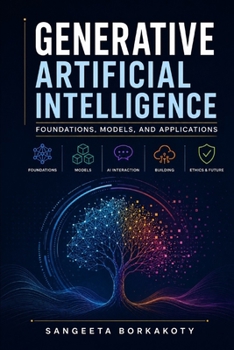
Generative Artificial Intelligence: Foundations, Models, and Applications
No Customer Reviews

Generative Artificial Intelligence: Foundations, Models, and Applications provides a comprehensive exploration of the technologies that power modern generative artificial intelligence. Designed for students, researchers, educators, software developers, and technology enthusiasts, the book bridges foundational concepts with the latest advances in AI, explaining not only what generative AI can do but also how it works behind the scenes. The book begins by tracing the evolution of artificial intelligence, from early symbolic systems and expert systems to machine learning, deep learning, and the emergence of large-scale foundation models. It introduces the mathematical and computational principles that underpin modern AI, including vectors, tensors, probability, optimization, embeddings, and neural network fundamentals, establishing the foundation required to understand contemporary generative models. Building on these fundamentals, the book explores the core architectures that enable AI to generate content. It explains neural networks, convolutional and recurrent models, autoencoders, generative adversarial networks (GANs), diffusion models, and, most importantly, transformer architectures. Readers gain a detailed understanding of how Large Language Models (LLMs) process prompts, tokenize text, compute attention, generate coherent responses, and produce human-like language through probabilistic prediction. The training pipeline of foundation models, including large-scale pretraining, fine-tuning, instruction tuning, reinforcement learning from human feedback (RLHF), and alignment techniques, is also examined. Beyond text generation, the book presents a comprehensive overview of multimodal AI, covering text-to-image generation, AI-assisted image editing, speech recognition, text-to-speech synthesis, music generation, voice cloning, video diffusion models, text-to-video systems, AI avatars, and synthetic media technologies. It demonstrates how modern AI models integrate multiple forms of data to create increasingly sophisticated multimedia content. The practical application of generative AI is addressed through prompt engineering, retrieval-augmented generation (RAG), vector databases, AI memory systems, tool use, autonomous agents, and multi-agent workflows. The book also explores the infrastructure required to deploy AI systems efficiently, including GPUs, TPUs, cloud computing, distributed training, model optimization, inference, APIs, and the growing ecosystem of commercial and open-source AI platforms. Recognizing that technological advancement must be accompanied by responsible development, the book examines critical issues such as hallucinations, bias, adversarial attacks, privacy, deepfakes, AI safety, alignment, governance, and emerging regulatory frameworks. It concludes by exploring the future of generative intelligence, including multimodal foundation models, autonomous AI agents, human-AI collaboration, Artificial General Intelligence (AGI), and the societal and economic transformations expected over the coming decade. Combining technical depth with accessible explanations, *Generative AI: From Prompt to Creation* equips readers with the knowledge needed to understand, evaluate, and build the next generation of intelligent systems in an increasingly AI-driven world.
Format:Paperback
Language:English
ISBN:B0H6XMBQHJ
ISBN13:9798184846125
Release Date:June 2026
Publisher:Independently Published
Length:172 Pages
Weight:0.52 lbs.
Dimensions:0.4" x 6.0" x 9.0"
Customer Reviews
0 rating
Copyright © 2026 Thriftbooks.com
Terms of Use | Privacy Policy | Do Not Sell/Share My Personal Information | Cookie Policy | Cookie Preferences | Accessibility Statement
ThriftBooks ® and the ThriftBooks ® logo are registered trademarks of Thrift Books Global, LLC
ThriftBooks ® and the ThriftBooks ® logo are registered trademarks of Thrift Books Global, LLC
